Showing posts with label Risen Body. Show all posts

Thursday, June 13, 2013

What Kind of Body Do We Receive In the Eucharist? The Body of Christ the Church


Here we come to a most wonderful teaching of our Catholic Faith. I’m speaking about the Church as the Body of Christ, or more formally known as the Mystical Body of Christ. If you haven’t read the previous two blog entries about the Body of Christ in it’s three states, then I invite you to do so. To sum it up again, there is the "historical" or what I often refer to as the earthly body of Christ. This is the body conceived in the womb of the Virgin Mary by the power of the Holy Spirit when the Son of God took flesh and dwelt among us (the Incarnation).
 
This earthly body was transformed after the death of Jesus in his Resurrection. It is now a glorified Body not limited by space or time nor subject to pain or death anymore. It is a transformed Body, so much so that Christ is called "the man of heaven" now. (See Catechism #646 HERE)
 
There is one more dimension of Christ’s body since his Resurrection: Christ no longer exists as an individual as we think of this reality on earth, but he is a person in Communion with others. His Communion first has always been as the Second Person of the Trinity, along with God the Father and the Holy Spirit; we cannot understand the Son of God apart from the Communion and Union of the Trinity. But in his risen humanity he is also united to his Body the Church in a real spiritual (i.e., Based in the Holy Spirit) union. The sacrament of married union is a sacrament of the relationship and union of Christ with his Bride the Church.
 
Orthodox Bishop John Zizioulas writes: "Christ, although a particular person, cannot be conceived in Himself as an individual...In other words, when we now say "Christ" we mean a person and not an individual; we mean ...Christ’s personal existence as a body or community." (Being As Communion, pp.110-111)
 
This is none other than the teaching of the New Testament, particularly when St. Paul teaches that through the Holy Spirit (thus in a spiritual way) we are united to the Body of Christ, his Church. St. Paul makes a further distinction when he says Christ is the Head of the Body the Church. So just as in marriage, the two become one, yet remain two, so Christ unites himself to his Body the Church without sacrificing his unique being or the unique being of each of his members. (Go HERE for a comparison of the Scripture texts on this subject)
 
St. Augustine and many early Church Fathers referred to this union of Christ as Head and his Body the Church as "the Whole Christ’ (in Latin Totus Christus; see, for example Catechism #795 HERE). So Christ has his earthly human body which is now transformed into his Risen Body; and to his Risen Body he unites us, baptized into his Body the Church, the Whole Christ.
 
Catholics (and the Orthodox Church) have always held onto this communal or communion view of Christ and his Church. In the Catholic world view one cannot have only Christ and not his Body the Church. There are a lot of Catholics that try to live that way ("not practicing"), but it is like they live a handicapped life, apart from the life-giving sacramental life Christ gives us in the Church, especially in the Eucharist.
 
It is the Whole Christ, then that we receive in the Eucharist. Or to put it another way, when we receive Christ in the Eucharist, truly and really, we also receive one another. Not in the same way as Christ  Present substantially or in his essence, but rather we receive his relationship with each of his members and so we receive this relationship also with one another as one in Christ.
 
 
I could be misunderstand as reducing the Eucharist to just a social bonding with one another, little different from a fraternity or club. That is not at all what I mean. I follow the Catholic teaching , articulated by St. Augustine:
 
"If, therefore, you are the Body of Christ and His members, your mystery is presented at the table of the Lord, you receive your mystery. To that which you are, you answer: `Amen’…Be a member of Christ’s Body, so that your `Amen’ may be the truth." (Sermon 272)
 
"There you are on the table [the altar], there you are in the cup." (Sermon 229)
 
"If you receive them well, you are that which you receive."(Sermon 227)


At every turn the Christ we receive in the Eucharist and all his benefits and reality become ever more wondrous and awesome to think about!
 

Thursday, June 6, 2013

What Kind of Body Do We Receive In the Eucharist? It Is the Risen Body of Christ

 
In my last entry I pointed out that it is not Christ’s mortal flesh and blood we receive in the Eucharist; he does not exist in our earthly state anymore. We receive his spiritualized Risen Body. So when we say we eat his Body and drink his Blood, we are not cannibals eating mortal flesh (the definition of cannibalism), but communicants, receiving in Eucharistic Communion the Risen Body of Christ into our lives.
 
What is a Risen Body Like?
 
Now what has fascinated me for many years is what a Risen body is like. We have no way of scientifically investigating this because we are dealing with a reality that goes beyond our earthly knowledge. The First Letter of John captures this mystery by saying; "Dear friends, now we are the children of God, and what we will be has not yet been made known [manifested]. But we know that when Christ appears, we shall be like him, for we shall see him as he is." (1 John 3:2)
 
Still, by looking at the New Testament teaching on the subject, especially based in the Resurrection Accounts about Jesus in the Gospel, we have some idea of what a Risen body is like. The Catechism conveniently sums up this teaching under the heading "The Condition of Christ’s Risen Humanity":
 
Catechism #645 [Citation] states that the Risen body of Christ is the same body in which he was crucified, but it now possesses "the new properties of a glorious body: not limited by space and time but able to be present how and when he wills." It says the Risen body of Christ is no longer confined to this earth but belongs "to the Father’s divine realm."
 
 
Catechism #646 [Citation] states "Christ's Resurrection was not a return to earthly life...In his risen body he passes from the state of death to another life beyond time and space. At Jesus' Resurrection his body is filled with the power of the Holy Spirit: he shares the divine life in his glorious state, so that St. Paul can say that Christ is ‘the man of heaven’."
 
The Isenheim Altarpiece  by  Matthias Grunewald
The artist shows the Risen Christ's Body to be similar
yet different from an earthly body
St. Paul wrote about the Risen body being "a spiritual body" (see 1 Corinthians 15:35-56 HERE and my last blog entry  HERE paragraphs 6&7). He did not mean that the Risen Body of Christ wasn’t still a body. As cited above, it is the same body of Jesus that suffered and died on the Cross, yet it is in a different state of being now. His body doesn’t return to an earthly life. His spiritual body means a Spirit-filled body, a real body but transcending time and space.
 
That’s about all we can say with certainty. The rest is speculative. What I wonder about is the material component of the Risen body. The human person is a union of matter and spirit (soul):
 
Catechism #365: "The unity of soul and body is so profound that one has to consider the soul to be the ‘form’ of the body: i.e., it is because of its spiritual soul that the body made of matter becomes a living, human body; spirit and matter, in man, are not two natures united, but rather their union forms a single nature."
 
In the Resurrection we are talking about the human person not ultimately losing this unity of body and soul. Our destiny is not to be only souls in heaven. In the Resurrection there will be a transformation of both soul and matter, retaining the essential unity of the human person as spirit and matter.
 
But what does this matter become in the Resurrection? It seems that in the Risen state we are talking about a body that consists of "Risen matter." His Risen body is physical, but as I keep repeating, not of earthly physicality. We need a new kind of word for this and what some have proposed is the term "transphysical." The prefix "trans-" in this term would mean "transcending" or beyond" the physical of this life. Even Pope Benedict XVI used this term in one case I know of, in speaking about the Resurrection.
 
 
I have also researched the term "spiritualized matter" and need to read more about this from a Catholic and Christian perspective. There are lots of New Age and nonChristian claims for "spiritualized matter," but they don’t concern me. A spiritualized matter in the Christian sense means a Spirit-filled matter, a matter totally under the influence of the Holy Spirit in a way that our mortal bodies are not. The Holy Spirit will somehow, in a manner that is mystery here on earth, transform our flesh, our material bodies, to not be limited by space and time or mortality. "As fire transforms into itself everything it touches, so the Holy Spirit transforms into the divine life whatever is subjected to his power" (Catechism #1127).
 
Such musings help us, I think, to avoid the crude misconception that we are eating Christ’s mortal or pre-Resurrection flesh and blood in the Eucharist. It also reminds us that the Resurrection and the things of God incorporate the realities of this life and yet transcend these same realities because we are talking about a different dimension of reality.
 
I am reminded of an episode from the original Star Trek TV series called "In the Wink of an Eye." In it the crew of the Enterprise keep hearing this buzzing sound around them after visiting a certain planet. We eventually come to learn that what they are hearing is a group of aliens who live at a much higher acceleration in time than humans do. The crew cannot see these aliens. But Captain Kirk, through the action of these aliens, becomes accelerated also. Now from his perspective, the Enterprise crew members are moving so slowly that they seem to be at a standstill, and now Kirk can see the aliens, who move so quickly that the human eye cannot perceive them. Eventually all things are made right.
 
This episode stays with me all these years because it opens the imagination to think about possible realities we would not be able to see in our limited human state. I’m not saying that the Risen life is an accelerated existence, but for us it is real and it exists in a state that far surpasses our perception. Nevertheless, it is in the Eucharist that we receive this divine reality in Communion with the Risen Body and Blood, of the entire Christ.
 
There is still more to consider about the Body we receive in the Eucharist, which I will share next week.


Friday, May 31, 2013

What Kind of Body of Christ Do We Receive in the Eucharist?


This upcoming Sunday we celebrate the Solemnity of the Most Holy body and Blood of Christ (Corpus Christi). This celebrates our Catholic Faith that Christ is "really real" in the Eucharist, referring to his Real Presence under the appearances of the Consecrated Bread and Wine. In this Sunday’s bulletin I briefly write about this and the subject of transubstantiation.
 
What I am interested in exploring here is the question "what kind of Body of Christ do we receive in the Eucharist?" (I am assuming that when we speak of his Body, we usually mean also his Blood). It helps me to list the ways "the Body of Christ" are used in the New Testament and by the Catholic Church:
 
First, there is the body which the Son of God took in the womb of the Virgin Mary as Christ Jesus, who is fully human and fully God. This body was like ours in that it grew in maturity and thus was changeable, had an earthly life needing food and water, and was limited by time and space, as well as being mortal: capable of suffering and dying. Let’s call this Jesus’ "earthly body or flesh and blood."
 
Second, there is the Risen Body of Christ. On the future day of Resurrection our bodies will be like his: a body which is ours, yet which is radically transformed from this earthly life. The Risen Body of Jesus is the Body he has now and forever. It does not change in any way as a Risen Body. It does not have an earthly life needing food or water. It is not limited by time and space, nor is it mortal: there is no physical suffering in the Risen body, neither death. This Risen Body would not bleed.
 
It is important to remember that the risen Body of Christ (or ours) is not a resuscitated body; it’s not like Jesus died and then came back to an earthly life. A Risen Body is transformed into a reality that transcends this earthly reality of ours. So neither is the Resurrection just a "reassembling" of all the material of our body, even after it has turned to dust. It is, again, a different reality.
 
St. Paul describes it this way: "[Our body is first] sown [i.e., born] a natural body; it is raised a spiritual body. If there is a natural body, there is also a spiritual one." (1 Corinthians 15:44) But certainly Paul doesn’t mean that we will have no material body or only one of pure spirit (such as God is Spirit and not matter). No he says that we will be like Christ (verse 49) and of course Christ bodily rose from the dead. But the point is that this Risen Body is not like our natural and earthly bodies in certain ways. The commentary in the Revised New American Bible observes:
 
"[1 Corinthians 15:42-44 shows] "The principles of qualitative difference before and after death [15:36-38] and of diversity on different levels of creation [15;39-41] are now applied to the human body. Before [the Resurrection of the dead]: a body animated by a lower, natural life-principle (psyche) and endowed with the properties of natural existence (corruptibility, lack of glory, weakness). After [the Resurrection of the dead]: a body animated by a higher life-principle (pneuma; cf 1 Cor. 15:49) and endowed with other qualities (incorruptibility, glory, power, spirituality), which are properties of God himself."
 
Now I have spent more time describing how a Risen Body differs from our natural body because we really don’t know in this life, and have no way of knowing scientifically, exactly what a Risen body is. It doesn’t belong to this world, but to "the life of the world to come." But also, it is the Risen Body of Christ that we receive in the Eucharist.
 
There is one final way that the term "Body of Christ" is used: we speak of the "Mystical" or "Ecclesial" Body of Christ, i.e. the Church united to the risen Christ. This refers to the union of the Risen Christ with the members of his Church, which is called his Mystical Body. The word "mystical" is used with a number of nuances: "it is called mystical body, because it is neither a purely physical nor a purely spiritual unity, but supernatural...The relation of the faithful with Christ is mystical, not physical." (See more here) It also refers to a union which is sacramental and involves the sacraments, also called "the mysteries":
 
"Spiritual progress tends toward ever more intimate union with Christ. This union is called "mystical" because it participates in the mystery of Christ through the sacraments - "the holy mysteries" - and, in him, in the mystery of the Holy Trinity. God calls us all to this intimate union with him, even if the special graces or extraordinary signs of this mystical life are granted only to some for the sake of manifesting the gratuitous gift given to all." (Catechism # 2014)
 
I don’t want to make this entry too long or who will read what I write? So I am going to comment more on these matters in the next several weeks; the subjects of the Risen Christ in the Eucharist and the Mystical Body of Christ are very inspiring to me, stimulating a number of ideas, and subjects I have spent a lot of time researching and thinking about. So you also come to know me better by what moves me.
 
Return to HomePage

Thursday, April 11, 2013

Book of Revelation: The Heavenly Liturgy

This Sunday we hear about John’s vision of the Heavenly Liturgy recorded in the Book of Revelation:

                                  "I, John, looked and heard the voices of many angels
                                   who surrounded the throne
                                   and the living creatures and the elders.
                                   They were countless in number, and they cried out in a loud voice:
                                  ‘Worthy is the Lamb that was slain
                                   to receive power and riches, wisdom and strength,
                                   honor and glory and blessing.’

                                   Then I heard every creature in heaven and on earth
                                   and under the earth and in the sea,
                                   everything in the universe, cry out:
                                  ‘To the one who sits on the throne and to the Lamb
                                   be blessing and honor, glory and might,
                                   forever and ever.’
                                   The four living creatures answered, ‘Amen,’
                                   and the elders fell down and worshiped." (Rev 5:11-14)

Mural from St Benet's Chaplaincy, Queen Mary's, University of London


I love and am inspired by the thought of this Heavenly Liturgy. It is the worship which is an ecstasy of love offered eternally in heaven to God the Father through God the Son in the Holy Spirit by the angels and saints, Mary the Mother of God and all the blessed of heaven.
 
I say it is an ecstasy of love because we don’t usually appreciate the act of worship as it could be if we were free of all earthly limitations and distractions, not to mention the deadliness of sin. If you were to tell most Catholics that their future in heaven is eternal worship, they might not be very enthused. For them this is better than eternal damnation, but barely!
 
But worship is love, the delight of all love, unending love. With God, it is our highest expression of love and by "ecstasy" I mean that it takes us beyond our self, of which bodily ecstasy is but a hint of what heaven will be like.
 
We pursue many pleasures, physical and spiritual, because they give us delight. But in this world they always must come to an end, because we cannot sustain delight at all times (for example we must sleep and have our responsibilities, etc.) But not so in heaven. The great St. Thomas Aquinas writes about this:
 
"Whatever is delightful is there [in heaven] in superabundance. If delights are sought, there [in heaven] is supreme and most perfect delight. It is said of God, the supreme good: ‘Boundless delights are in your right hand.’"
 
Again, eternal life consists of the joyous community of all the blessed, a community of supreme delight, since everyone will share all that is good with all the blessed. Everyone will love everyone else as himself, and therefore will rejoice in another’s good as in his own. So it follows that the happiness and joy of each grows in proportion to the joy of all." [For full passage HERE


When I began reading classical Catholic works in College on the road to becoming Catholic, I read another Thomas, Thomas Kempis in The Imitation of Christ. There he also writes about transcendent love:
 
"Nothing is sweeter than love, nothing stronger, nothing higher, nothing wider,
nothing more pleasant, nothing fuller or better in heaven or earth;
for love is born of God, and can rest only in God above all created things.
 
"Love flies, runs, leaps for joy; it is free and unrestrained.
Love gives all for all,
resting in One who is highest above all things,
from whom every good flows and proceeds.
Love does not regard the gifts, but turns to the Giver of all good gifts.
 
"Love knows no limits, but ardently transcends all bounds.
Love feels no burden, takes no account of toil,
attempts things beyond its strength;
love sees nothing as impossible,
for it feels able to achieve all things.
Love therefore does great things;
it is strange and effective;
while he who lacks love faints and fails."
 
Now here is something interesting about our bodies becoming risen bodies like Christ’s in "the life of the world to come." Greek philosophy before the time of Christ taught that the immaterial soul was "trapped" in "the prison" of the material body which weighs the soul down. In some ways this is true because we usually feel more of life’s limitations in our bodies than in our souls: we grow tired, we age, bodily addictions can harm us. The Greek ideal, then, was to transcend the material and bodily realities.
 
However, the Hebrew mind set of the Old Testament and of Jesus as a Jew is that the human person is a unity of body and soul. And the teaching about the resurrection of our bodies is that our bodies will have a place in our heavenly life. I like to think about how Aquinas says "If delights are sought, there [in heaven] is supreme and most perfect delight," and I believe that we need a risen body to be able to enjoy the fullness of all bodily delight. In other words, it will be our soul and body that will enjoy the delights of heaven. Our earthly bodies, as I mentioned are limited, but not our risen bodies.
 
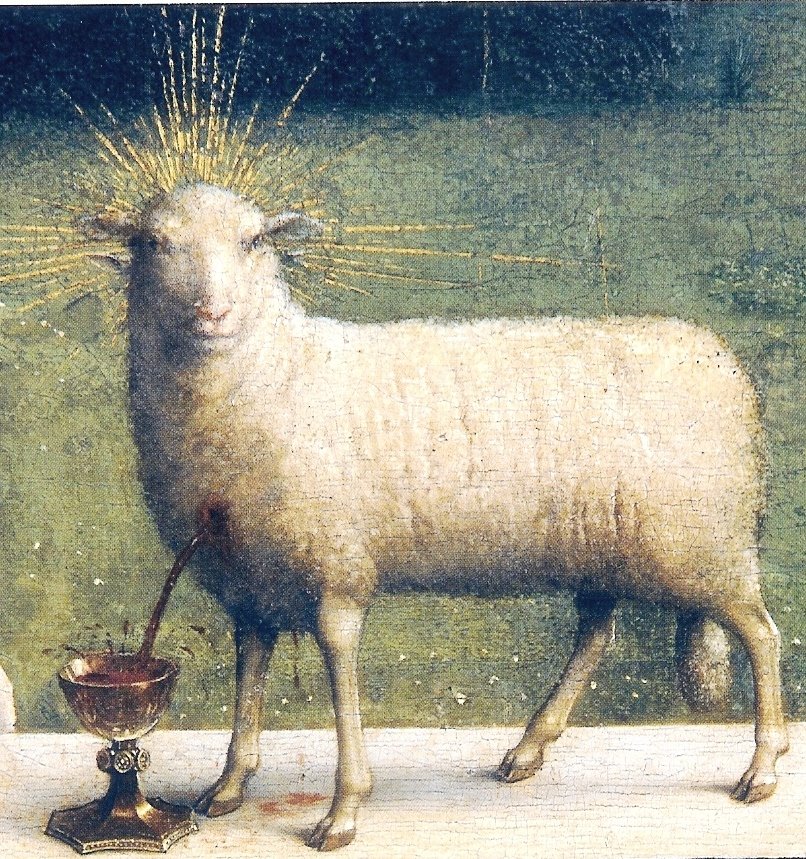
So, returning to John’s vision in the Book of Revelation, the heavenly liturgy (worship) and delight of love in heaven by the blessed community of heaven centers upon Christ, the Lamb that was slain yet is risen and lives. John sees God sitting on a throne in heaven and with him the Lamb of God, who is Christ. In our earthly liturgy we say a number of times "Lamb of God you take away the sins of the world, have mercy on us." The lamb imagery refers to the Jewish Temple sacrifices. Christ’s being slain, that is, dying on the Cross is the prefect sacrifice of love offered for us and our salvation. Without his sacrifice and his love we would be damned, for it is love that saves us. So this what John means when he sees this Lamb who was slain.
 
Detail Lamb of God by van Eyck
 
 
And we hear this Sunday in the Second Reading from the Book of Revelation one of the many references to the thanksgiving, love and worship given to Christ in heaven. But I shall share more about this next week.
 
Listen to Handel’s "Worthy is the Lamb" from The Messiah HERE
 

Thursday, April 4, 2013

Wounds of the Risen Christ

This Sunday, continuing the celebration of the Easter Season, is Divine Mercy Sunday. This Sunday we hear the Gospel account of how the Risen Jesus appeared to his Apostles, and also to Thomas, and showed them his wounds from the Cross. Thomas had insisted that he would only believe that Jesus was risen from the dead if he could actually touch Jesus’ wounds and hence earned the name "Doubting Thomas."


Certainly we can say that the Divine Mercy of Jesus is focused in his wounds which open to his Sacred Heart. In my spiritual journey these wounds of Jesus attract me very much with the sacrificial love they represent. These wounds, especially his Five Wounds (in his hands, feet and side), are marks of the Passion and Cross which he still carries in his glorified, risen body after his Resurrection.
 
The Resurrection means a new and glorified body, called a new creation, not a resuscitated mortal body brought back to mortal existence which can die again. In such a glorified body we would not expect to find wounds; we would expect to find perfection, which presumably excludes any defect which we associate with wounds, scars or other physical disfigurements.


Yet it is in that glorified, risen body that Jesus keeps showing his disciples his wounds taken from the Cross. One preacher said that the reasons for this are first that the wounds show the disciples that the one appearing to them as one who could pass through locked doors (they thought he was a ghost at first! See Luke 24:36-40), is the same Jesus who they knew had been crucified. Second, they are the proofs of his love for us which he demonstrated in his Sacrifice on the Cross. And, third, they tell us that we too will have wounds if we love as Christ loves, but also share his new life as a result. (C. H. Spurgeon Sermons Vol.5:254)
 
I think how some societies celebrated the scars of warriors as marks of valor and battle. Christ’s wounds are signs of his suffering for us and this out of love. The Catechism teaches: "By embracing in his human heart the Father's love for men [all], Jesus ‘loved them to the end’, for ‘greater love has no man than this, that a man lay down his life for his friends.’(John 13:1; 15:13.) In suffering and death his humanity became the free and perfect instrument of his divine love which desires the salvation of men." (#609)

The Jerusalem Cross
depicts the Five Wounds of Christ

 
The Cross and the Wounds Christ received on the Cross are connected, then, with the love of God for us. They tell us that this love is sacrificial (giving) and also that this love is compassionate. Compassion literally means "to suffer with" another, to share another’s suffering, at least in heart and moral support, if not physically also.
 
I think about the wounds in my own life when I have suffered. I have come to know that whatever suffering I may have suffered in my life has helped make me a more compassionate priest, though I have a lot of room to grow in this compassion. For example, I went through a terrible time of depression and panic attacks during one period of my life, even as a priest. Before this, I remember when I was in the Seminary that one of my former College roommates who was in Medical School at the time told me that he had to take off a semester because he was experiencing panic attacks. I didn’t know what he was talking about and I couldn’t appreciate then what serious suffering he was going through. After I had my own experience of this suffering, I can sympathize with others who suffer this kind of affliction and be of help, especially to reassure that this affliction can be cured since I experienced healing of this woundedness.
 
Thank God we don’t have to experience every suffering imaginable to be compassionate! However, Christ Jesus did suffer every wound there is except sin, and I cannot imagine the enormity of such suffering. The result, however, is described by the author of the Letter to the Hebrews 4:14-16:
 
"Therefore, since we have a great high priest who has passed through the heavens, Jesus the Son of God, let us hold fast our confession. For we do not have a high priest who cannot sympathize with our weaknesses, but One who has been tested in all things as we are, yet without sin. Therefore let us draw near with confidence to the throne of grace, so that we may receive mercy and find grace to help in time of need."
 
And St. Bernard of Clairvaux says:
 
"He was thinking thoughts of peace, and I did not know it, for who knows the mind of the Lord, or who has been his counselor? But the piercing nail has become a key to unlock the door, that I may see the good will of the Lord. And what can I see as I look through the hole? Both the nail and the wound cry out that God was in Christ reconciling the world to himself. The lance pierced His soul and came close to His heart, so that he might be able to feel compassion for me in my weaknesses.
 
"Through these sacred wounds we can see the secret of His heart, the great mystery of love, the sincerity of His mercy with which he visited us from on high. Where have Your love, Your mercy, Your compassion shone out more luminously than in Your wounds, sweet, gentle Lord of mercy? More mercy than this no one has than that he lay down his life for those who are doomed to death." (Homily on the Song of Songs)
 
 
The Wounds of Christ also remind us of the essential union of Christ’s Cross and Resurrection. There is not one without the other, so as I often say: "There is no Cross without the Resurrection but also there is no Resurrection without the Cross." This is the Paschal Mystery of Christ: his Dying and Rising, and it is the pattern of our lives.
 
I see in the wounds of Christ, as others have, the reminder also that the path of Christ’s love will inevitably involve a certain amount of wounding, of suffering for others. A story is told about people who didn’t get involved in helping others in life: "We will go before God to be judged, and God will ask us: 'Where are your wounds?' and we will say, 'We have no wounds.' And God will ask, 'Was nothing worth fighting for?'" It might also be asked: "Was there nothing worth suffering for, giving and loving enough to be vulnerable and wounded?"
 
Here is a favorite prayer which mentions the wounds of Christ:
 
Anima Christi (Soul of Christ)
 
Soul of Christ, sanctify me;
Body of Christ, save me;
Blood of Christ, inebriate me;
Water from the side of Christ, wash me;
Passion of Christ, strengthen me;
 
O good Jesus, hear me;
within Your wounds, hide me;
let me never be separated from You;
 
from the evil one, protect me;
at the hour of my death, call me;
and bid me come to You;
that with Your saints,
I may praise You forever and ever.