Showing posts with label Love. Show all posts

Thursday, December 26, 2013

ON the Feast of Stephen

When I became a Catholic I no longer held the mainly Protestant view that Christmas is only one day of the year; rather I learned that Christmas is a season that extends from December 25th to Epiphany and beyond to the Solemnity Baptism of the Lord.
 
(The Christmas Season was originally 12 Days and ended with Epiphany on January 6. The Feast of the Baptism of the Lord was added to the Season in 1969 to be celebrated the Sunday after Epiphany. In the United States Epiphany is celebrated on the first Sunday after January 1)
 
“The Stoning of St. Stephen,” by Pietro da Cortona, C. 1660
So it seemed odd to me at the time that on the second day of the Christmas Season, i.e. on December 26th, the Church celebrates the Feast of the Martyr Stephen. (I wasn’t familiar with the Christmas carol "Good king Wenceslas": "Good King Wenceslas looked out/ On the feast of Stephen...") We are supposed to be celebrating a Christmas Season of joy and yet the second day of this Season is about a martyr’s suffering and death?
 
A number of years after I became a Catholic and had been ordained a Priest, I began to understand Christmas in a deeper manner than simply the birthday of Jesus in Bethlehem, as important as this is. I began to understand the purpose of this birth much better, though it had always been there in the Angel’s message to the shepherds: "Unto you is born this day a Savior, who is Christ the Lord."
 
Thus, the Son of God took flesh and was born of Mary to be our Savior: to grow up and lead us God through his life, and his death on the Cross and his Resurrection to new life. All this is the mystery of God’s love which forgives and converts us from sin’s refusal to love as God loves. One way I heard this described is that the Creche is always in the shadow of the Cross. I would add that the Creche is also illuminated by the Resurrection.
 
So, the martyrdom of St. Stephen is in imitation of following the suffering and death of Christ. Stephen even says: " "Lord, do not hold this sin against them" (Acts 7:60. Compare to Jesus’s words on the Cross: "Father, forgive them for they do not know what they are doing") Christ’s death demonstrated the great love of God for us; Stephen’s death demonstrates his love for God.
 
This puts me in mind of how God’s love is a sacrificial love: it gives to the other and this sometimes includes suffering for the loved on. So this love is what brought the Son of God to us, and this was already being revealed in Bethlehem at his birth.
 

Thursday, November 14, 2013

Is Death The End?


I found this quote among my computer files which gave rise to a reflection on death and "the end":
 
"In the solemn opening of the second part of the Gospel, (Jn 13:1), we are told that the hour had come for Jesus to return to his Father.

Then John adds the unforgettable line that ‘Jesus having loved his own who were in the world, he loved them eis telos, to the end, a phrase that can be and has been interpreted to mean
to the end of his life,
to the end of our life,
to the end of the world,
to the extreme limit possible,
a love without limit and conditions and boundaries,
a love without end and a love that would achieve its final purpose and goal.

All that Jesus would do and say and suffer from now on in the upper room,
in the garden, during the trials by Jewish and Roman authorities,
the way of the cross and death on the cross are especially signs
of that agape eis telos, love to the end and love without end."
 
(Joseph Kallarangatt, "Johannine Understanding of Mission," [text rearranged]
 
The Gospel of John captures so much of the meaning of the life of Jesus in that verse: "Jesus having loved his own who were in the world, he loved them to the end." (John 13:1)


The phrase "the end" has several meanings, as Kallarangatt notes. This passage is speaking about the death Jesus is about to undergo. As I wrote last week, death can be seen as the enemy, especially when it is thought to be "the end," that life is no more. When a book announces "The End," we know the book is finished. That means there is nothing more to the story to be told.

If a book is very well written and inspires us, we don’t want it to end. We want more. Our lives are the same way; we do not want them to end–we want more. Even if our lives are full of suffering we still hope for a new chapter where all is better. This "wanting more" is our innate desire for eternal life, I believe.
 
An interesting thing about a book that has come to "The End" is that the book itself still exists, only the story of the book ends. Perhaps this is an analogy of our life and death: when we die, the story of our life in this world is ended; but who we are (like the book) still remains. I’ll come back to this shortly.
 

From www.beautifulbookcovers.com/this-is-not-the-end-of-the-book
 
 
Jesus wrestled with the fact that he was going to suffer and die. In the Garden of Gethsemene he prayed that the Cup of Suffering might pass him by; but he added "Not my will, Father, but Thy will be done." Jesus was fully human and he had our normal life instinct for self-preservation. Yet he subjects that self-preservation to the will of God which puts self-donation first. That is because self-giving is integral to love and God is love (See 1 John 4:8 HERE ).
 
The Sacrament of the Anointing of the Sick mentions: "Moreover he [Jesus] loved us so much that he died for our sake." Pope John Paul II taught that "The meaning of life is found in giving and receiving love...Love also gives meaning to suffering and death." (Encyclical Evangelium Vitae §81)
 
Jesus loved us "to the end." As Kallarangatt noted, the word translated "end" in the original Greek telos, can mean "final purpose" or "final goal" which is related to the meaning of something. So it is like when we speak of the "end-zone" in football. We don’t mean the zone is "no more"; we mean that getting the ball to that zone is the purpose of the game, literally "the goal." (You can see how the word "end" can have two meanings. The end of a football game can mean "it is over" (referring to time) or less common, "to make many goals so as to win" (referring to purpose).
 
In Jesus' case the end of his life in reference to time was when he died on the Cross; but the end of his life–meaning the purpose of his life–was to fully love God and love us with the love of God in his human life. If we are united to him in Baptism, then that is our purpose also, with "the love of God poured out in our hearts by the Holy Spirit given to us." (Romans 5:5) And when we die, we die in his love. So his love is the goal, the purpose of our life.
 
As we know, however, Jesus’ death on the Cross was not really the end of Jesus himself. It was the end of his earthly life; but we believe he rose again from the dead.
 
Now to use our book analogy, the Resurrection doesn’t mean that the book was buried and then dug up and "The End" was crossed out (could be a pun) and a new chapter is started.


Many think of Resurrection that way: as a return to this life but without end. No; Resurrection means the "transformation" of our human life into a different kind of existence. So the book analogy would be this: after the book ends, it is "recreated" into a new kind of book, made  of this earth, but also now made of heaven. And this "heavenly book" includes a first  chapter about our life on earth. But now, the story of our life never ends. The second chapter continues the  love story between God and ourselves, begun in the first chapter, but that love "never ends."  So death is not the end, love and everlasting life is the end--the goal.


"And I saw the dead, great and small, standing before the throne,
 and  books were opened. Then another book was opened, which is the Book of Life.
And the dead were judged by what was written in the books,
according to what they had done." (Revelation 20:12)
 

Thursday, August 15, 2013

Beautiful Faith

I once read a statement which said "the problem with what the Church teaches is not that no one believes that what we teach is true or good; rather they do not find our teaching beautiful."
 
I do think there are those who oppose the truth taught by the Church; on the other hand, probably the great majority of our society doesn’t even think about what we teach, instead they are indifferent. But the statement that what we teach is not seen as beautiful, this I understand as saying we don’t make the teaching of truth attractive enough: beauty attracts.
 
I see in Pope Francis a Catholic teacher who attempts to make the teaching of the Gospel attractive. I don’t mean that he waters down the truth or compromises it one single bit. Instead he speaks to the listeners’ imagination to help them understand the Gospel and how it is to be lived.
 
And Christ calls us to love, to a love which is "good, true and beautiful:" (to use the ancient philosophical ideals).


Saint Augustine says: "Beautiful is God, the Word with God ...
He is beautiful in heaven, beautiful on earth; beautiful in the womb,
beautiful in his parents' arms, beautiful in his miracles,
beautiful in his sufferings; beautiful in inviting to life,
beautiful in not worrying about death,
beautiful in giving up his life and beautiful in taking it up again;
he is beautiful on the Cross, beautiful in the tomb, beautiful in heaven.
Listen to the song with understanding, and let not the weakness of the flesh distract your eyes from the splendour of his beauty."
 
Listen to "Now I Walk In Beauty" HERE
 

Thursday, May 23, 2013

Practical Understanding of the Trinity of God

6th Century Mosaic at San Vitale Church, Ravenna, Italy
of the Three Angels who visited Abraham (Genesis 18)
often used to image the Triune God
 
This Sunday will be the Solemnity of the Most Holy Trinity. Over my years as a Priest I have several topics which I have extensively studied; one of those topics is the Trinity. I have read quite a few books on this subject. Unlike the "popular thinking" that one cannot understand the Trinity: One God in Three Persons, I have found much to understand and appreciate. I don’t expect to understand everything about God because God transcends our understanding, but that doesn’t mean that there isn’t much to understand to begin with.
 
Through revelation we are given this fact that God is One God in Three Persons: Father, Son, and Holy Spirit. "God is one but not solitary." (Catechism #254) God fundamentally is the relationship of love between the Father and the Son and the Holy Spirit. Our God is The Relationship of Love without beginning and end: 1 John 4:8 says: "God is love." The Catechism comments on this passage from John:
 
"But St. John goes even further when he affirms that ‘God is love’: God's very being is love. By sending his only Son and the Spirit of Love in the fullness of time, God has revealed his innermost secret: God himself is an eternal exchange of love, Father, Son and Holy Spirit, and he has destined us to share in that exchange." (#221; emphasis added)
 
When we think about it, to say that "God is love" already carries within this statement that God is not solitary, but rather would have at least one other to love. Indeed, we are told that God the Father has always loved God the Son and God the Son has always returned this love to the Father. But the revelation concerning God the Holy Spirit means that the love of Father and Son is not exclusionary. This love has always included "Another," the Holy Spirit who shares eternally in the love who is God.
 
Now, God has created all things and sustains all reality in it being. Since God is relationship, this means that all reality is in the form of relationships, whether of human beings with God or one another; or animals among themselves; or animate creatures within inanimate environments. We should expect this when we look at Nature and see an interdependence of all things, which now includes our understanding of ecological relationships:
"God wills the interdependence of creatures. The sun and the moon, the cedar and the little flower, the eagle and the sparrow: the spectacle of their countless diversities and inequalities tells us that no creature is self-sufficient. Creatures exist only in dependence on each other, to complete each other, in the service of each other." (Catechism #340; emphasis in the text)
 
There is a reflection of the Triune God’s diversity (Three distinct Persons) and unity (One God) reflected in the diversity of creation which is still one reality.


Now what does this mean for my life and the lives of others? We are taught that we humans are created "in the image of God," to be "like God." The Church has meditated upon what it means to be "in the image" and "like God." The image refers to our capacity to know and love. To be "like God" is to actually know and love others, including God. Just as God loves as Three Persons, so humans are to love one another and form personal relationships with one another. When we do this, we are being like God; we are fulfilling our capacity to know and love.
 
In addition, we who are baptized into the Father and the Son and the Holy Spirit, are given this knowledge of the nature of God as Communion and we are to live in this Communion, and with the help of God, form Communion and Community with others.
 
All this, I see, has great implications for our identity and purpose in this world. It means that anything we do to build loving relationships with others is being "like" God: the Triune God and thus giving God glory. When a man and woman love one another in marriage, when families are formed and nurtured, when friendships are made and deepened, when people work together to achieve the common good, when Churches are formed to know, love and serve God and others, when neighborhoods are strengthened, when communities are built, when nations live in justice and respect, and creation’s relationships are respected and human persons are fulfilled in relationships, all such activities are done in the image and likeness of the God who is Relationship, Communion, and Love, i.e. the Most Holy Trinity.

Now this arises from understanding and appreciating the Trinity of God. Is that so hard to understand? I think not!
 
Listen HERE to "If Ye Love Me" by Thomas Tallis (c1505 –1585) based on John 14:15-17a where Jesus, the Son of God, asks God the Father to send Another Comforter, the Holy Spirit. The Gospel of John is very Trinitarian.
 

Thursday, April 11, 2013

Book of Revelation: The Heavenly Liturgy

This Sunday we hear about John’s vision of the Heavenly Liturgy recorded in the Book of Revelation:

                                  "I, John, looked and heard the voices of many angels
                                   who surrounded the throne
                                   and the living creatures and the elders.
                                   They were countless in number, and they cried out in a loud voice:
                                  ‘Worthy is the Lamb that was slain
                                   to receive power and riches, wisdom and strength,
                                   honor and glory and blessing.’

                                   Then I heard every creature in heaven and on earth
                                   and under the earth and in the sea,
                                   everything in the universe, cry out:
                                  ‘To the one who sits on the throne and to the Lamb
                                   be blessing and honor, glory and might,
                                   forever and ever.’
                                   The four living creatures answered, ‘Amen,’
                                   and the elders fell down and worshiped." (Rev 5:11-14)

Mural from St Benet's Chaplaincy, Queen Mary's, University of London


I love and am inspired by the thought of this Heavenly Liturgy. It is the worship which is an ecstasy of love offered eternally in heaven to God the Father through God the Son in the Holy Spirit by the angels and saints, Mary the Mother of God and all the blessed of heaven.
 
I say it is an ecstasy of love because we don’t usually appreciate the act of worship as it could be if we were free of all earthly limitations and distractions, not to mention the deadliness of sin. If you were to tell most Catholics that their future in heaven is eternal worship, they might not be very enthused. For them this is better than eternal damnation, but barely!
 
But worship is love, the delight of all love, unending love. With God, it is our highest expression of love and by "ecstasy" I mean that it takes us beyond our self, of which bodily ecstasy is but a hint of what heaven will be like.
 
We pursue many pleasures, physical and spiritual, because they give us delight. But in this world they always must come to an end, because we cannot sustain delight at all times (for example we must sleep and have our responsibilities, etc.) But not so in heaven. The great St. Thomas Aquinas writes about this:
 
"Whatever is delightful is there [in heaven] in superabundance. If delights are sought, there [in heaven] is supreme and most perfect delight. It is said of God, the supreme good: ‘Boundless delights are in your right hand.’"
 
Again, eternal life consists of the joyous community of all the blessed, a community of supreme delight, since everyone will share all that is good with all the blessed. Everyone will love everyone else as himself, and therefore will rejoice in another’s good as in his own. So it follows that the happiness and joy of each grows in proportion to the joy of all." [For full passage HERE


When I began reading classical Catholic works in College on the road to becoming Catholic, I read another Thomas, Thomas Kempis in The Imitation of Christ. There he also writes about transcendent love:
 
"Nothing is sweeter than love, nothing stronger, nothing higher, nothing wider,
nothing more pleasant, nothing fuller or better in heaven or earth;
for love is born of God, and can rest only in God above all created things.
 
"Love flies, runs, leaps for joy; it is free and unrestrained.
Love gives all for all,
resting in One who is highest above all things,
from whom every good flows and proceeds.
Love does not regard the gifts, but turns to the Giver of all good gifts.
 
"Love knows no limits, but ardently transcends all bounds.
Love feels no burden, takes no account of toil,
attempts things beyond its strength;
love sees nothing as impossible,
for it feels able to achieve all things.
Love therefore does great things;
it is strange and effective;
while he who lacks love faints and fails."
 
Now here is something interesting about our bodies becoming risen bodies like Christ’s in "the life of the world to come." Greek philosophy before the time of Christ taught that the immaterial soul was "trapped" in "the prison" of the material body which weighs the soul down. In some ways this is true because we usually feel more of life’s limitations in our bodies than in our souls: we grow tired, we age, bodily addictions can harm us. The Greek ideal, then, was to transcend the material and bodily realities.
 
However, the Hebrew mind set of the Old Testament and of Jesus as a Jew is that the human person is a unity of body and soul. And the teaching about the resurrection of our bodies is that our bodies will have a place in our heavenly life. I like to think about how Aquinas says "If delights are sought, there [in heaven] is supreme and most perfect delight," and I believe that we need a risen body to be able to enjoy the fullness of all bodily delight. In other words, it will be our soul and body that will enjoy the delights of heaven. Our earthly bodies, as I mentioned are limited, but not our risen bodies.
 
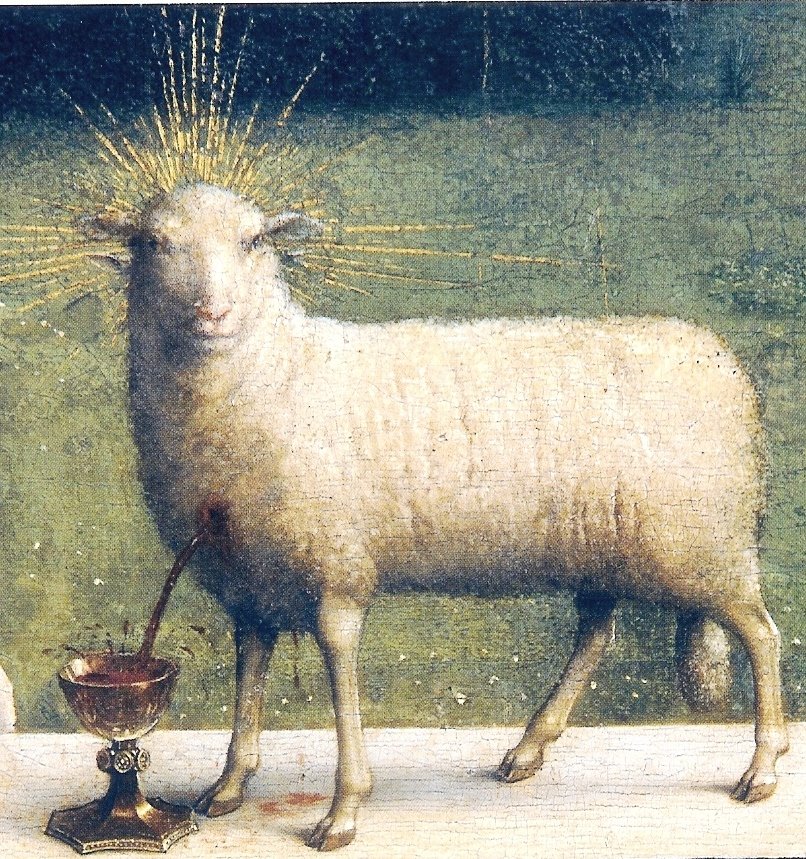
So, returning to John’s vision in the Book of Revelation, the heavenly liturgy (worship) and delight of love in heaven by the blessed community of heaven centers upon Christ, the Lamb that was slain yet is risen and lives. John sees God sitting on a throne in heaven and with him the Lamb of God, who is Christ. In our earthly liturgy we say a number of times "Lamb of God you take away the sins of the world, have mercy on us." The lamb imagery refers to the Jewish Temple sacrifices. Christ’s being slain, that is, dying on the Cross is the prefect sacrifice of love offered for us and our salvation. Without his sacrifice and his love we would be damned, for it is love that saves us. So this what John means when he sees this Lamb who was slain.
 
Detail Lamb of God by van Eyck
 
 
And we hear this Sunday in the Second Reading from the Book of Revelation one of the many references to the thanksgiving, love and worship given to Christ in heaven. But I shall share more about this next week.
 
Listen to Handel’s "Worthy is the Lamb" from The Messiah HERE
 

Thursday, April 4, 2013

Wounds of the Risen Christ

This Sunday, continuing the celebration of the Easter Season, is Divine Mercy Sunday. This Sunday we hear the Gospel account of how the Risen Jesus appeared to his Apostles, and also to Thomas, and showed them his wounds from the Cross. Thomas had insisted that he would only believe that Jesus was risen from the dead if he could actually touch Jesus’ wounds and hence earned the name "Doubting Thomas."


Certainly we can say that the Divine Mercy of Jesus is focused in his wounds which open to his Sacred Heart. In my spiritual journey these wounds of Jesus attract me very much with the sacrificial love they represent. These wounds, especially his Five Wounds (in his hands, feet and side), are marks of the Passion and Cross which he still carries in his glorified, risen body after his Resurrection.
 
The Resurrection means a new and glorified body, called a new creation, not a resuscitated mortal body brought back to mortal existence which can die again. In such a glorified body we would not expect to find wounds; we would expect to find perfection, which presumably excludes any defect which we associate with wounds, scars or other physical disfigurements.


Yet it is in that glorified, risen body that Jesus keeps showing his disciples his wounds taken from the Cross. One preacher said that the reasons for this are first that the wounds show the disciples that the one appearing to them as one who could pass through locked doors (they thought he was a ghost at first! See Luke 24:36-40), is the same Jesus who they knew had been crucified. Second, they are the proofs of his love for us which he demonstrated in his Sacrifice on the Cross. And, third, they tell us that we too will have wounds if we love as Christ loves, but also share his new life as a result. (C. H. Spurgeon Sermons Vol.5:254)
 
I think how some societies celebrated the scars of warriors as marks of valor and battle. Christ’s wounds are signs of his suffering for us and this out of love. The Catechism teaches: "By embracing in his human heart the Father's love for men [all], Jesus ‘loved them to the end’, for ‘greater love has no man than this, that a man lay down his life for his friends.’(John 13:1; 15:13.) In suffering and death his humanity became the free and perfect instrument of his divine love which desires the salvation of men." (#609)

The Jerusalem Cross
depicts the Five Wounds of Christ

 
The Cross and the Wounds Christ received on the Cross are connected, then, with the love of God for us. They tell us that this love is sacrificial (giving) and also that this love is compassionate. Compassion literally means "to suffer with" another, to share another’s suffering, at least in heart and moral support, if not physically also.
 
I think about the wounds in my own life when I have suffered. I have come to know that whatever suffering I may have suffered in my life has helped make me a more compassionate priest, though I have a lot of room to grow in this compassion. For example, I went through a terrible time of depression and panic attacks during one period of my life, even as a priest. Before this, I remember when I was in the Seminary that one of my former College roommates who was in Medical School at the time told me that he had to take off a semester because he was experiencing panic attacks. I didn’t know what he was talking about and I couldn’t appreciate then what serious suffering he was going through. After I had my own experience of this suffering, I can sympathize with others who suffer this kind of affliction and be of help, especially to reassure that this affliction can be cured since I experienced healing of this woundedness.
 
Thank God we don’t have to experience every suffering imaginable to be compassionate! However, Christ Jesus did suffer every wound there is except sin, and I cannot imagine the enormity of such suffering. The result, however, is described by the author of the Letter to the Hebrews 4:14-16:
 
"Therefore, since we have a great high priest who has passed through the heavens, Jesus the Son of God, let us hold fast our confession. For we do not have a high priest who cannot sympathize with our weaknesses, but One who has been tested in all things as we are, yet without sin. Therefore let us draw near with confidence to the throne of grace, so that we may receive mercy and find grace to help in time of need."
 
And St. Bernard of Clairvaux says:
 
"He was thinking thoughts of peace, and I did not know it, for who knows the mind of the Lord, or who has been his counselor? But the piercing nail has become a key to unlock the door, that I may see the good will of the Lord. And what can I see as I look through the hole? Both the nail and the wound cry out that God was in Christ reconciling the world to himself. The lance pierced His soul and came close to His heart, so that he might be able to feel compassion for me in my weaknesses.
 
"Through these sacred wounds we can see the secret of His heart, the great mystery of love, the sincerity of His mercy with which he visited us from on high. Where have Your love, Your mercy, Your compassion shone out more luminously than in Your wounds, sweet, gentle Lord of mercy? More mercy than this no one has than that he lay down his life for those who are doomed to death." (Homily on the Song of Songs)
 
 
The Wounds of Christ also remind us of the essential union of Christ’s Cross and Resurrection. There is not one without the other, so as I often say: "There is no Cross without the Resurrection but also there is no Resurrection without the Cross." This is the Paschal Mystery of Christ: his Dying and Rising, and it is the pattern of our lives.
 
I see in the wounds of Christ, as others have, the reminder also that the path of Christ’s love will inevitably involve a certain amount of wounding, of suffering for others. A story is told about people who didn’t get involved in helping others in life: "We will go before God to be judged, and God will ask us: 'Where are your wounds?' and we will say, 'We have no wounds.' And God will ask, 'Was nothing worth fighting for?'" It might also be asked: "Was there nothing worth suffering for, giving and loving enough to be vulnerable and wounded?"
 
Here is a favorite prayer which mentions the wounds of Christ:
 
Anima Christi (Soul of Christ)
 
Soul of Christ, sanctify me;
Body of Christ, save me;
Blood of Christ, inebriate me;
Water from the side of Christ, wash me;
Passion of Christ, strengthen me;
 
O good Jesus, hear me;
within Your wounds, hide me;
let me never be separated from You;
 
from the evil one, protect me;
at the hour of my death, call me;
and bid me come to You;
that with Your saints,
I may praise You forever and ever.


Thursday, March 28, 2013

The Triduum: The Three Holy Days and More Sacred Geography (The Upper Room, Calvary, and the Empty Tomb)

Lent has ended with the celebration of the Lord’s Supper on Holy Thursday Evening. We have now entered the Three Holy Days, also known as the Paschal or Easter Triduum (Latin for "Three Days").
 
I have been reflecting in this blog upon the "sacred geography" contained within the Gospel Readings of Lent. Now the Three Holy Days of Holy Thursday through Good Friday, Holy Saturday, and the Easter Vigil through Easter Sunday, have been described in one Church document as the "holy Mountain of Easter." As we shall see this "mountain" transcends any actual place or time. Still, in the celebration of the Three Holy Days three major geographical and historical places are mentioned and have the greatest spiritual significance: the Upper Room, Calvary, and the Empty Tomb.
 
This past Sunday–Palm Sunday–Jesus entered triumphantly into the City of Jerusalem. By entering into "the city," spiritually speaking, he is entering into the place or order and disorder, of civilization and crime, the place of much distraction and even greater temptation. Jerusalem is especially fraught with danger; as Jesus lamented, "Jerusalem, Jerusalem, who kills the prophets and stones those who are sent to her! How often I wanted to gather your children together, the way a hen gathers her chicks under her wings, and you were unwilling." (Matthew 23:37)
 
It will only be at the End of Time, in the Second Coming of Christ, that "the city," i.e., human civilization will be perfectly redeemed; the "old Jerusalem" will be replaced by the "New and Heavenly Jerusalem" which will come down from heaven to earth (Revelation 21:1-2) and there will be "new heavens and a new earth where... the justice of God will reside" (2 Peter 3:13).
 
The First Day Part I: Holy Thursday
 
In Jerusalem, reputedly on Mount Zion, Jesus and his disciples gather in the Upper Room where Jesus gives them and his Church forever the Eucharistic banquet. How I would love to live always in just a corner of that Upper Room. How I would love to see Jesus and his Apostles and to hear his voice. I would gladly serve them at Table and so I do at the Altar. But he calls me (and all disciples) to come closer to him, as did my Patron, St. John the Beloved, and rest upon his chest and listen to his Sacred Heart beat with love for us. This is why I chose the picture of St. John resting upon Jesus’s Heart at the Last Supper for my 25th Anniversary of Priestly Ordination for my holy card remembrance.
 
As part of climbing the holy Mountain of Easter, one must go up to the Upper Room, the place of the Eucharist, and not just on Holy Thursday. "I rejoiced when they said to me, ‘Let us go up to the House of the Lord.’" (Psalm 122) In every Eucharist we ascend spiritually with Christ to worship with him in the Heavenly Liturgy (the eternal worship that fills heaven with joy). We are reminded of this in the Eucharistic Preface where the Priest says "Lift up your hearts!" Every Eucharist, but especially the Sunday Eucharist which is more festive, is meant to elevate our hearts and minds heavenward. This is not by way of escape from the lowly duties of life but rather to inspire us by the love outpoured for us in the Mass, a love we bring into our daily lives.
 
In the Upper Room, on that night that Jesus gathered with his Apostles for a Passover meal, he also took the role of a servant and washed their feet. The Pope, Bishops, and Priests reenact this on Holy Thursday at the Mass of the Lord’s Supper. In Holy Faith’s Tabernacle oratory there is a pitcher, bowl and towel always on display with other devotional art. The Mass calls us to this love of others that serves, as Jesus served. Is not our new Pope Francis showing this by his example? One Seminary Professor once said that the ideal gift for any newly ordained Priest was a pitcher, bowl, and towel. I keep a small version of these on my office desk to remind me that I must lead by loving service.

The Upper Room now transcends time and place and can be found wherever the Eucharist is celebrated.
 
The First Day Part II: Good Friday
 
On Good Friday we remember the Crucifixion of Jesus and its meaning for our lives. It is also on our climb up the Mountain of Easter. From the standpoint of our sacred geography, the traditional site of the place where Jesus was crucified and then buried close by (See John 19:41-42) is found in Jerusalem in the Church of the Holy Sepulcher. In the First Century the site of Jesus’ crucifixion and burial would have been outside the city of Jerusalem. (See Hebrews 12:13-14; also executions and burials had to be outside the city walls in ancient times) The Emperor Constantine (4th Century) in his embrace of the formerly outlawed Christianity, built a church over the remembered site of Golgotha (in Hebrew), or Calvary (from Latin), where Jesus was crucified. It has been greatly elaborated over the centuries.

Today, when one enters the Church of the Holy Sepulcher, one can go up a stairway where a chapel has been built over the supposed place of crucifixion. From the 6th century, this place began to be called Mount Calvary, though it was  more a hill.
 
In our own parish church, as in many Catholic churches, one looks up at a Crucifix overlooking the Altar in the Sanctuary. It would seem that the suffering and death of Christ on the Cross would make us feel "down" rather than lift us up in some way (remember we are supposed to be going up the holy mountain of Easter). But Jesus himself says: "And I, if I be lifted up from the earth, will draw all things to myself. (Now this he said, signifying what death he should die.)" (John 12:32-33) Jesus is of course lifted up on the Cross.
 
 
The Cross expresses the depths of God’s love for us in the sacrificial love of God’s Son, Jesus, who in becoming human died for us. It is precisely this love that lifts us up from being "down." ("He brought me up out of the pit of destruction, out of the miry clay, And He set my feet upon a rock making my footsteps firm." –Psalm 40:2)
 
An Anglican Clergyman, Dick Tripp, writes:
 
"Love is self-giving for the benefit of others and in God’s case the ‘others’ were those who had rebelled against him. The proof of genuine love is not merely a feeling; it is an action....We tend to think of love in emotional terms, but the New Testament concept of love is more focused on active self-giving. And the greater the cost of that self-giving, the greater the love. It was on the night before his crucifixion that Jesus said to his disciples, ‘Greater love has no one than this: to lay down one’s life for one’s friends’ (John 15:13). Because there never has been, nor could be, a greater cost than that endured by Father and Son on Calvary, this is what defines for all time the true nature of love—and the true character of God. Pastor and Bible teacher Paul Rees said: ‘The cross does not so much reveal God’s infinite intellect as it reveals his heart.’ Someone else has said, ‘On the Mount of Beatitudes Christ opened his mouth and taught the people: on the mount of Calvary he opened his heart and showed [it to] the people.’"
 
The crucifixion of Jesus happened "once for all." (Hebrews 10:10) It happened at a certain time and at a certain place, the place perhaps enshrined now in the Church of the Holy Sepulcher. But the reality of the Cross also has now transcended time and place. That reality is the love of God "in cruciform" which transcends time and place and so is available everywhere.
 
The Second Day: Holy Saturday
 
Yet how do we know that the love of God shown in Christ on the Cross has not come to an end when Christ died on the Cross and was then buried in a tomb? That Christ died and was buried is remembered on the Second Day of the Three Holy Days we are celebrating. This Second Day is often overlooked because there is no liturgical celebration for this day except some of the prayer of the Liturgy of Hours (for example, in our parish there is celebrated Morning Prayer on Holy Saturday).
 
Spiritual author Christine Valters Paintner writes:
 
"Before we rush to resurrection we must dwell fully in the space of unknowing, of holding death and life in tension with each other, to experience that liminal place so that we become familiar with its landscape and one day might accompany others who find themselves there and similarly disoriented. The wisdom of the Triduum is that we must be fully present to both the starkness of Friday and to the Saturday space between, before we can really experience the resurrection. We must know the terrible experience of loss wrought again and again in our world so that when the promise of new life dawns we can let it enter into us fully in the space carved by loss."
 
For me, Holy Saturday represents the aftermath of suffering and death before grief is finished and something new emerges from the ashes or grave of our experience. It is waiting for comfort, healing, new purpose. For we who believe in Christ, it is waiting for his Resurrection. Many people live in this "in between" place at one time or another. It is, then, waiting outside the Tomb.
 
Holy Saturday is waiting to be lifted up again. Without this hope and trust, we would despair.
 
I have faith that this waiting "in between" death and life will lead to the Passover Mystery of Christ who passed from death to life and that it will become a reality in my life and in the lives of those I serve. I have faith because I have experienced it so often in my own life and have seen it in the lives of others where I thought grief and suffering would crush them.
 
The Third Day: The Easter Vigil and Easter Sunday
 
At the summit of the Triduum and the holy Mountain of Easter is the Resurrection represented by the Empty Tomb. ("But at daybreak on the first day of the week [the women] took the spices they had prepared and went to the tomb. They found the stone rolled away from the tomb; but when they entered, they did not find the body of the Lord Jesus." Luke 24:1-3 proclaimed at the Easter Vigil)
 
The Resurrection tells us that the sacrificial love which Christ showed us on the Cross is not defeated by the violence, seeming failure, and death inflicted by the Cross. If Jesus had not risen from the Tomb, it would have appeared that death was stronger than this love. But Christ is Risen and this is what makes all the difference in the world. So we are not exempt from suffering in this world, just as Jesus was not exempt but shared our sufferings and still does. Like him we have our crucifixions and Holy Saturdays–the Resurrection does not take these away but assures us that love will lift us up and renew us in Christ. There is no Cross without the Resurrection and there is no Resurrection without the Cross.

Like a story that comes to the end and yet returns to the beginning, the Cross and Resurrection, this Passover Mystery of Christ’s Dying and Rising, always brings us back to the Upper Room again. That is to say, we remember and we have made present to us the Crucified yet Risen Christ in the Eucharist he gave to us to celebrate in the Upper Room. May we always return and ascend to that Upper Room, lift up the Cross of Christ and receive the Risen Jesus who will lift us up from the Tomb and fill our emptiness with unending, life changing, and victorious love!
 
The Third Day
 
The immovable stone tossed aside,
The collapsed linens,
The blinding angel and the chalky guards:
All today like an old wood-cut.
 
The earthquake on the third day,
The awakened sleeper,
The ubiquitous stranger, gardener, fisherman:
Faded frescoes from a buried world.
 
Retell, renew the event
In these planetary years,
For we were there and he is here:
It is always the third day.
 
Our world-prison is split;
An elder charity
Breaks through these modern fates.
Publish it by Telstar,
Diffuse it by mundo vision.
 
He passes through the shattered concrete slabs,
The vaporized vanadium vaults,
The twisted barbed-wire trestles.
 
A charity coeval with the suns
Dispels the deep obsessions of the age
And opens heart-room in our sterile dream:
 
A new space within space to celebrate
With mobiles and new choreographies,
A new time within time to set to music.
 
— Amos Niven Wilder

Return to Home Page

Thursday, January 24, 2013

Opening Up to God

I preached this homily in 2009. It touches upon some of the great themes of Catholicism, such as sacramentality, the communal emphasis, and openness to experiencing Christ through others. I thought it might  reveal what inspires me personally.


The Homily: Many of us here have probably heard of Helen Keller. Helen contracted a high fever when she was 19 months old and was left blind and deaf as a result. Of course she had not learned to speak. One can barely imagine being more isolated than to not be able to see or hear or speak. Much like the deaf mute man in today’s Gospel.
 
If you’ve seen the old movie "The Miracle Worker," then you know the rest of the story about Helen Keller is pure inspiration. Helen had been born in a time when little was understood about disabilities. But her mother was determined that something or someone could help Helen, now a young child. She hired a teacher, Anne Sullivan, who had learned a new method for working with the deaf and blind. Anne had been trained to teach by touch, using her fingers on Helen’s hands to spell out words. At first, Helen, was almost uncontrollable, not understanding Anne’s attempts. But one day the magical moment came when finally her teacher spelled out the word "water" on Helen’s hand and pouring water from a pump on Helen’s other hand.
 
And Helen finally got it. She suddenly understood. The moment in the movie shows what it must have been like for Helen, to suddenly have her world opened up–she was able to learn and to communicate, she was freed from a long loneliness and isolation.
 
It’s interesting to think of Helen’s story in relation to the Gospel story we heard today. That man who was deaf and mute was blessed like Helen to have people who did not give up the hope of helping another, a loved one, be healed or assisted. Because the Scripture says "Some people brought a deaf and mute man to Jesus."
 
At first I missed that detail. It’s very similar to another story of healing where some friends of a paralytic man made a hole through the roof of the house Jesus was in, and lowered their friend down to Jesus. How many times are we brought to Jesus by others? Almost everyone of us here was brought to Church, to be introduced to Jesus, by our parents when we were young.
 
We can bring people to Jesus in prayer. If called and trained, we can bring Jesus in the Sacrament of Holy Communion to the sick. God’s people, in fact, are supposed to look for every way to help others in need and bring the heart of Jesus into every situation of life.
 
There’s something else about this story: Jesus uses clay and spit, and his own touch, to minister healing. He also speaks his word to the man "Ephphatha: Be Opened". This reminds me of how Jesus uses both Word and Sacrament in communicating his life to us. Protestants are much more verbal or Word oriented. Their services are almost all speaking. But Catholics from the first century, by the example of Christ, have spoken the Word of Christ in the Scriptures, but also used the material creation to communicate God’s love as well:
 
We call it sacrament. It’s like when Anne Sullivan was teaching Helen Keller through touch and the feel of water. God uses water to baptize us, immerse us into the life of Christ. God uses bread and wine in the Eucharist to give us the Risen Christ. The Church lays hands upon the sick, like Jesus did, and anoints with oil.
 
And Jesus especially brings his compassion to others through his Body, his members, the Church. He uses our hands and our words and our care to communicate God’s love, if we let him.
 
When we realize that and begin to cooperate with Jesus in bringing healing and help and hope and care to others, then indeed a new world will open up to us: the world of God’s love and compassion celebrated here. "Ephphatha: Be Opened."


Thursday, December 27, 2012

He Came to Lead Us into Beauty


"Good Shepherd" by William Dyce


At Christmas, especially, many Catholic Churches are decorated as beautifully as possible. Some Protestant churches are suspicious of such decorations, fearful that all that "stuff" will distract from a "pure" worship and focus upon God. Yet the Catholic instinct, as soon as the early persecutions ended (by mid-4th century), has been that beauty in our churches focuses and deepens our appreciation for God’s beauty, for we believe God is All-Beauty.

I have reflected upon this previously (HERE) and I believe it is part of the sacramental approach of the Catholic Church, shared by the Orthodox Churches and to some degree by certain Protestant churches, as well. 

This is how the Catechism (CCC#41) explains it:

 "All creatures bear a certain resemblance to God, most especially man, created in the image and likeness of God. The manifold perfections of creatures - their truth, their goodness, their beauty all reflect the infinite perfection of God. Consequently we can name God by taking his creatures' perfections as our starting point, 'for from the greatness and beauty of created things comes a corresponding perception of their Creator'."  (Wisdom 13:5)

I have studied the subject of "religious beauty" for a number of years now. It is quite fascinating to me. I remember once reading a certain Christian author’s critique of the Church’s preaching and teaching. He said, many do not dispute that what we teach is true or reasonable (though many others  would disagree); rather we have not made our teaching and preaching beautiful enough. Love should attract...

The late Pope John Paul II wrote about the "Consecrated life" of those men and women in religious orders, such as Sisters. But we are first consecrated by Baptism, so I believe that the Pope’s words can apply appropriately to all of us:

Saint Augustine says: "Beautiful is God, the Word with God ... He is beautiful in heaven, beautiful on earth; beautiful in the womb, beautiful in his parents' arms, beautiful in his miracles, beautiful in his sufferings; beautiful in inviting to life, beautiful in not worrying about death, beautiful in giving up his life and beautiful in taking it up again; he is beautiful on the Cross, beautiful in the tomb, beautiful in heaven. Listen to the song with understanding, and let not the weakness of the flesh distract your eyes from the splendour of his beauty."

The quest for divine beauty impels consecrated persons to care for the deformed image of God on the faces of their brothers and sisters, faces disfigured by hunger, faces disillusioned by political promises, faces humiliated by seeing their culture despised, faces frightened by constant and indiscriminate violence, the anguished faces of minors, the hurt and humiliated faces of women, the tired faces of migrants who are not given a warm welcome, the faces of the elderly who are without even the minimum conditions for a dignified life.
              Quoted in John Paul II, POST-SYNODAL APOSTOLIC EXHORTATION
                                        VITA CONSECRATA. March25, 1996: 24 &75)

For a long time I have seen that in our Catholic Faith, Beauty and Justice are partners in serving God. Beauty without justice (especially caring for those unjustly treated), could lead to an escapist aestheticism. But justice without beauty would be a diminished justice, since justice is to bring us into "right relationship" with  God, who is Just, Good, True, and Beautiful in his love. (To read more about this: HERE)

If we follow Christ, he will lead us as the Good and Beautiful Shepherd into his beauty and truth and empower us to work to restore beauty and dignity to people’s lives, the original beauty for which God created us. This is why he came into our world and why we make Christmas as beautiful as we can.

Thursday, December 20, 2012

Christmas Wonder

I have always loved Christmas. Some of my earliest memories as a child (3 or 4 years old) were of the Christmas tree and its ornaments and colored lights. Being a baby boomer, I remember those big ole painted light bulbs on the tree:

I remember the shiny Christmas ornaments that after a few uses had the paint chip off. Like these:

I remember the tree sprayed with this white stuff that looked like snow and decorated with tinsel. I found a picture on the Internet that remeinded me of those Christmas mornings with tree and gifts and stockings:

I can remember being taken downtown as a child to Birmingham where I was born. I again was perhaps 4 years old since my family moved to Norfolk, Virginia when I was 5. I can remember seeing the decorations strung over the streets and the light posts had big bells or bows as decorations.


It certainly made an impression upon me. Everything about Christmas impressed my young imagination with a delight of color and song and decoration and beauty. It was all about wonder and still is.

My family was Methodist but not overly religious. We didn’t even have a manger when I was growing up. But I have a very fond memory of every Christmas Eve my mother would read to me, and then also to my brother and sister when they came along, two stories. The first was The Night Before Christmas. The second was the account of the birth of Jesus according to the Gospel of Luke. I of course loved The Night Before Christmas and its pictures of Santa and flying Reindeer. I liked the sound of "Now dash away, dash away, dash away all."

But even my childish mind also liked the story about Jesus. It has details to capture our imagination, still, even as adults: the journey to Bethlehem, the fact that there was no room for Mary and Joseph in the inn, the birth among animals, the angels and shepherds.


In 1965, when I was 10 years old, I saw the premier of a "Charlie Brown Christmas Special." At one point Charlie Brown asks: ""Isn’t there ANYONE who knows what Christmas is all about?!?!" And then Linus recites from Luke 2. It was the story my mother read to me every year! I was so impressed that Linus could recite it from memory that I also memorized the Christmas story from the Gospel of Luke. (CBS executives wanted to delete that part by Linus when it was first produced but thankfully left it in. Imagine that. Christ is, after all, "the reason for the season")

One last remembrance. As a child, I was also told continuously before Christmas that if I didn’t behave, Santa would bring me a bag of switches (I suppose the Southern equivalent of coal). I’m sure I was more "naughty than nice," children get so wound-up before Christmas, yet Santa always delivered! What a lesson of grace in my childhood.

As I have grown older, I have come to think this is the true message of Christmas: grace comes even when we don’t expect it or especially when we don’t deserve it. Love is that way and Christmas is about God’s love. But like love, we must accept it; like a gift at Christmas we must open it; like the wonder of Christmas, we must stop and see it again as a child. These are some of the deeper reasons I love Christmas.