Showing posts with label Heavenly Liturgy. Show all posts

Friday, May 10, 2013

The Eucharist: Door to Heaven


I shall share some thoughts about the Ascension as it relates to the Eucharist which also may speak to your faith, as it does to mine.
 
When Jesus ascends into heaven, he enters heaven as our Great High Priest. In the Jewish worship offered in the Temple, the High Priest would enter annually into the inner sanctum, the Holy of Holies, on the Day of Atonement to offer blood sacrifice for the sins of the People. The author of the Letter to the Hebrews compares Jesus’ entry into heaven to this entry of the High Priest into the Holy of Holies. The Ascended Christ brings his own Sacrifice on the Cross for our sins before God and opens the way for us to follow him to heaven. (See Hebrews 4:14; 9:11; 10:19,20)


In heaven Christ is our Priest. He presides over the Heavenly Liturgy which includes the angels and saints and all the blessed of heaven. As Priest he offers his One Sacrifice, once offered on the Cross, i.e. himself in his Body and Blood. The Catechism (#1187) says about this Heavenly Liturgy:
 
"The liturgy is the work of the whole Christ, head and body. Our high priest celebrates it unceasingly in the heavenly liturgy, with the holy Mother of God, the apostles, all the saints, and the multitude of those who have already entered the kingdom."
 
Christ also makes intercession for us in heaven. (See Hebrews 7:25) This is why at our Sunday Mass, at the time of the Intercessions, we say we are joining our Intercessions with those of Christ.
 
When we celebrate our Eucharist on earth, we spiritually ascend to heaven, to participate by faith in the Heavenly Liturgy with Christ. I have learned a great deal about this "ascension in the liturgy" from an Orthodox Priest and Liturgical scholar, Fr. Alexander Schmemann. He writes:
 
"But the liturgy of the Church is always...a lifting up, an ascension. The Church fulfills itself in heaven in that new eon which Christ has inaugurated in His death, resurrection and ascension, and which was given to the Church on the day of Pentecost as its life..." (For the Life of the World, p.42)
 
The U.S. Bishops say much the same thing about Christ’s Presence in the Eucharist:
 
"Christ does not have to leave where he is in heaven to be with us. Rather, we partake of the heavenly liturgy where Christ eternally intercedes for us and presents his sacrifice to the Father and where the angels and saints constantly glorify God and give thanks for all his gifts." ( "The Real Presence of Jesus Christ in the Sacrament of the Eucharist: Basic Questions and Answers," USCCB, June 2001)
 
In the oldest Roman Eucharistic Prayer (Now called Eucharistic Prayer I), after the Consecration, the Priest prays:
 
"In humble prayer we ask you, almighty God:
command that these gifts be borne
by the hands of your holy Angel                                                                       
to your altar on high
in the sight of your divine majesty,
so that all of us, who though this participation
at the altar
receive the most holy Body and Blood of your Son,
may be filled with every grace and heavenly blessing."
 
This prayer refers to the altar in heaven mentioned in several places in the Book of Revelation (). Christ is Present at that altar. As one commentator says: "The community in the church on earth is mystically gathered at God’s altar on high." (Paul Turner, The Supper of the Lamb, p.89)  Our altar  on earth participates in the Heavenly Altar.


The question as to how Christ is now in heaven (after his Ascension), yet Really Present in the earthly Eucharist, "under" the appearance of the Consecrated Bread and Wine, was the subject of some debate in the Middle Ages. Does he "come down" from heaven to be Present in the earthly Eucharist? The Bishops answer he does not; and yet he is truly Present to us at the Eucharist.
 
For myself, I understand this matter in this way: first, when we speak of Christ’s being in heaven, we cannot really say "he is up in heaven" or that "he comes down from heaven" (i.e. after his Ascension). Heaven is not a location like a geographical location on earth. The Catechism (#2794) says: "[Heaven] does not mean a place (‘space’), but a way of being; it does not mean that God is distant, but majestic. Our Father is not ‘elsewhere’: he transcends everything we can conceive of his holiness."
 
I am able to understand this by imaging heaven as a "dimension," so to speak, that transcends our world of time and space. Perhaps I first thought this from a passage (again) from Fr. Alexander Schmemann. He speaks of the Liturgy of the Eucharist as a "journey into the dimension of the Kingdom [of God]":
 
"We use this word ‘dimension’ because it seems the best way to indicate the manner of our sacramental entrance into the risen life of Christ. Color transparencies ‘come alive’ when viewed in three dimensions instead of two. The presence of the added dimension allows us to see much better the actual reality of what has been photographed. In very much the same way, though of course any analogy is condemned to fail, our entrance into the presence of Christ is an entrance into a fourth dimension which allows us to see the ultimate reality of life." (For the Life of the World, p.26-27)
 
(Because of Einstein, we often call time the fourth dimension, but Schmemann is not referring to that description; indeed, his fourth dimension would be eternity)
 
As a "fourth dimension," paradoxically heaven is nowhere and everywhere. It is like the Ultimate Reality "behind" our earthly reality. (We have to keep using spatial language for a reality that is not spatial) I can image the Eucharist, then, as opening, a portal, so to speak, to heaven: "the gates of heaven."
 
The Psalmist says: "I rejoiced with those who said to me, ‘Let's go to the Lord's house!’ Now our feet are standing in your gates, O Jerusalem." (Psalm 122:1-2)
 
The Psalmist was speaking of the earthly Jerusalem. With the Eucharist, I am thinking of the heavenly Jerusalem, about which I have written quite a bit lately. What I am saying is that in the Eucharist we are standing spiritually within the heavenly gates of the New Jerusalem.
 
When I think this way, I think of C.S. Lewis’s The Lion, the Witch, and the Wardrobe, where four children discover in a closet wardrobe a doorway to a magical country called Narnia. (Narnia also is not on the same time as our world).
 
Another way of seeing this is that heaven and earth join in the Eucharistic celebration. Christ does not leave heaven, nor do we literally leave earth, but we meet and receive the Risen Christ in heaven in the Eucharist, the "meeting place" at "the gates." Again the Psalmist says: "Open for me the gates of righteousness; I will enter and give thanks to the Lord. This is the gate of the Lord through which the righteous may enter. I will give you thanks, for you answered me; you have become my salvation." (Psalm 118.19-21)


Listen HERE to Handel's  "Lift up your heads, O ye gates" sung by  the Brandemburg Consort and the Choir of King's College Cambridge
 

Thursday, April 18, 2013

More on the Heavenly Liturgy

For several Sundays in the Easter Season, in our Second Readings from the Book of Revelation, we are hearing about the worship that centers around the Risen Christ in heaven. This week, from Rev 7:9, 14b-17 we hear:
 
"I, John, had a vision of a great multitude,
which no one could count,
from every nation, race, people, and tongue.
They stood before the throne and before the Lamb,
wearing white robes and holding palm branches in their hands.
 
"Then one of the elders said to me,
‘These are the ones who have survived the time of great distress;
they have washed their robes
and made them white in the blood of the Lamb.
 
"‘For this reason they stand before God’s throne
and worship him day and night in his temple.
The one who sits on the throne will shelter them.
 
"‘They will not hunger or thirst anymore,
nor will the sun or any heat strike them.
For the Lamb who is in the center of the throne
will shepherd them and lead them to springs of life-giving water,
and God will wipe away every tear from their eyes.’"
 
The White Robed Multitude in Heaven
I was raised in the Methodist Church. At that time, in the late ‘60's and early ‘70's, the Methodist Church still had a classical "Protestant style" of worship, which is to say everything centered upon the preaching of the Word of God with a great deal of singing. Once a month or less often we celebrated the Lord’s Supper with Communion consisting of a small wafer and grape juice in individual little cups. I am grateful for my Methodist youth for in that Church I met Jesus, fellowshiped with other youth seeking to know Jesus more, and was given a great love for Scripture and singing.
 
In my Senior year in High School, a friend invited me to attend a Eucharist on Wednesday evening at her Episcopal Church. I had to ask her what "Eucharist" meant; but I accepted her invitation and when I attended I was captivated by a different style of worship that I had never before experienced. While the Episcopal Church is solidly Protestant, it worships now in a very Catholic style when it celebrates its Eucharist.
 
I was struck that evening by seeing an altar, a priest in vestments, bread and wine, ritual responses like "The Lord be with you," and the familiar singing, but in such reverence and beauty. When I started attending Sunday Eucharist at that Church, there was even more ceremony, with big processions with banners, and everything seemed so exalted. Wasn’t this how God was intended to be worshiped? I didn’t know this until much later, but my soul was very much disposed to the Catholic style of worship. Eventually (obviously) I entered the Catholic Church, returning to the source.
 
The Priest in this Episcopal Church was named Fr. John (a good name for a priest) and I was very impressed with his teaching. I remember him once saying: "I am comfortable with a Church that worships in the style described in the Book of Revelation." Something clicked inside of me that recognized the truth of this statement. Having read the Book of Revelation I remembered how the worship in heaven was described as angels and the blessed singing and rejoicing. They rarely sat but rather stood and knelt and "fell down in worship" a lot. Revelation describes in heaven a sanctuary, an altar, incense, praises of the Lamb of God (the Agnus Dei), the angelic song of "Holy, Holy, Holy" (the Sanctus) lampstands, vestments, priests and more. These were the things I didn’t experience in the classical Protestant style, but which I was experiencing in what is called the more Catholic, liturgical style of that Episcopal Church I was attending.
 
John's Vision in Revelation
Some Scripture scholars are beginning to consider that the Book of Revelation was indeed also describing some of the early Church’s style of Liturgy (the public worship of the Church that is patterned in certain ways of ritual and elements used for the worship of God). There is no doubt that the Heavenly Liturgy (again the worship done in heaven) described in the Book of Revelation reflects many elements of the worship conducted in the Jewish Temple detailed in the Old Testament. Jesus himself and the early Christians in Jerusalem worshiped in the Temple.
 
Constantine
Certainly when the early Church (up until the 4th century) was worshiping in small groups in largehouses, the Eucharist was more simple just as when a Mass may be celebrated in a small group setting today. Many elements like incense and vestments and very developed rituals and prayers weren’t incorporated into the Church’s worship until after the early persecutions ended and the legalizing of Christianity by the Emperor Constantine (in 313 AD). Then large churches were built and the respect and signs given to the Emperor were transferred to the worship of God who is greater than any Emperor and more deserving of such honor.
 
 
However, as the Mass was becoming a more exalted style of Liturgy, the Church did not forget the worship described in the Book of Revelation. And there was a very definite belief that the Earthly Liturgy of the Church was a participation in the Heavenly Church’s Liturgy; the Mass is a foretaste of the glories of heaven and it is a true communion in the Heavenly Liturgy.
 
This is described in the Catechism in several places. For example, in #1090:
 
"In the earthly liturgy we share in a foretaste of that heavenly liturgy which is celebrated in the Holy City of Jerusalem toward which we journey as pilgrims, where Christ is sitting at the right hand of God, Minister of the sanctuary and of the true tabernacle. With all the warriors of the heavenly army we sing a hymn of glory to the Lord; venerating the memory of the saints, we hope for some part and fellowship with them; we eagerly await the Savior, our Lord Jesus Christ, until he, our life, shall appear and we too will appear with him in glory."
 
I said last week, the worship of heaven is an unending of ecstasy of love, the highest and supreme expression of love for God and one another and it is full of all delights; but here on earth we don’t always experience our worship as heavenly or even that exalted. This is  because we don’t usually appreciate fully the act of worship due to our earthly limitations and distractions, not to mention the deadening of our souls by sin. What we need is our imaginations stretched, as by the Book of Revelation, to see in our inner heart the glories of the Lord. As a contemporary Christian song prays:
 
"Open the eyes of my heart, Lord
Open the eyes of my heart
I want to see You
I want to see You
 
"To see You high and lifted up                                                       
Shinin' in the light of Your glory
Pour out Your power and love
As we sing holy, holy, holy
 
"Open the eyes of my heart, Lord
Open the eyes of my heart
I want to see You
I want to see You


Thursday, April 11, 2013

Book of Revelation: The Heavenly Liturgy

This Sunday we hear about John’s vision of the Heavenly Liturgy recorded in the Book of Revelation:

                                  "I, John, looked and heard the voices of many angels
                                   who surrounded the throne
                                   and the living creatures and the elders.
                                   They were countless in number, and they cried out in a loud voice:
                                  ‘Worthy is the Lamb that was slain
                                   to receive power and riches, wisdom and strength,
                                   honor and glory and blessing.’

                                   Then I heard every creature in heaven and on earth
                                   and under the earth and in the sea,
                                   everything in the universe, cry out:
                                  ‘To the one who sits on the throne and to the Lamb
                                   be blessing and honor, glory and might,
                                   forever and ever.’
                                   The four living creatures answered, ‘Amen,’
                                   and the elders fell down and worshiped." (Rev 5:11-14)

Mural from St Benet's Chaplaincy, Queen Mary's, University of London


I love and am inspired by the thought of this Heavenly Liturgy. It is the worship which is an ecstasy of love offered eternally in heaven to God the Father through God the Son in the Holy Spirit by the angels and saints, Mary the Mother of God and all the blessed of heaven.
 
I say it is an ecstasy of love because we don’t usually appreciate the act of worship as it could be if we were free of all earthly limitations and distractions, not to mention the deadliness of sin. If you were to tell most Catholics that their future in heaven is eternal worship, they might not be very enthused. For them this is better than eternal damnation, but barely!
 
But worship is love, the delight of all love, unending love. With God, it is our highest expression of love and by "ecstasy" I mean that it takes us beyond our self, of which bodily ecstasy is but a hint of what heaven will be like.
 
We pursue many pleasures, physical and spiritual, because they give us delight. But in this world they always must come to an end, because we cannot sustain delight at all times (for example we must sleep and have our responsibilities, etc.) But not so in heaven. The great St. Thomas Aquinas writes about this:
 
"Whatever is delightful is there [in heaven] in superabundance. If delights are sought, there [in heaven] is supreme and most perfect delight. It is said of God, the supreme good: ‘Boundless delights are in your right hand.’"
 
Again, eternal life consists of the joyous community of all the blessed, a community of supreme delight, since everyone will share all that is good with all the blessed. Everyone will love everyone else as himself, and therefore will rejoice in another’s good as in his own. So it follows that the happiness and joy of each grows in proportion to the joy of all." [For full passage HERE


When I began reading classical Catholic works in College on the road to becoming Catholic, I read another Thomas, Thomas Kempis in The Imitation of Christ. There he also writes about transcendent love:
 
"Nothing is sweeter than love, nothing stronger, nothing higher, nothing wider,
nothing more pleasant, nothing fuller or better in heaven or earth;
for love is born of God, and can rest only in God above all created things.
 
"Love flies, runs, leaps for joy; it is free and unrestrained.
Love gives all for all,
resting in One who is highest above all things,
from whom every good flows and proceeds.
Love does not regard the gifts, but turns to the Giver of all good gifts.
 
"Love knows no limits, but ardently transcends all bounds.
Love feels no burden, takes no account of toil,
attempts things beyond its strength;
love sees nothing as impossible,
for it feels able to achieve all things.
Love therefore does great things;
it is strange and effective;
while he who lacks love faints and fails."
 
Now here is something interesting about our bodies becoming risen bodies like Christ’s in "the life of the world to come." Greek philosophy before the time of Christ taught that the immaterial soul was "trapped" in "the prison" of the material body which weighs the soul down. In some ways this is true because we usually feel more of life’s limitations in our bodies than in our souls: we grow tired, we age, bodily addictions can harm us. The Greek ideal, then, was to transcend the material and bodily realities.
 
However, the Hebrew mind set of the Old Testament and of Jesus as a Jew is that the human person is a unity of body and soul. And the teaching about the resurrection of our bodies is that our bodies will have a place in our heavenly life. I like to think about how Aquinas says "If delights are sought, there [in heaven] is supreme and most perfect delight," and I believe that we need a risen body to be able to enjoy the fullness of all bodily delight. In other words, it will be our soul and body that will enjoy the delights of heaven. Our earthly bodies, as I mentioned are limited, but not our risen bodies.
 
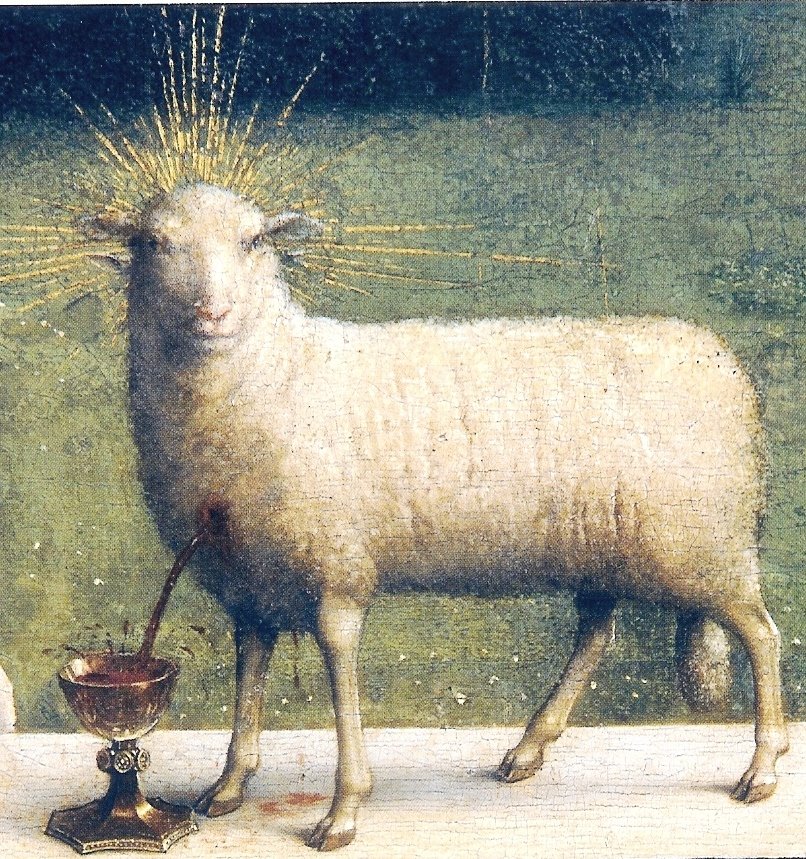
So, returning to John’s vision in the Book of Revelation, the heavenly liturgy (worship) and delight of love in heaven by the blessed community of heaven centers upon Christ, the Lamb that was slain yet is risen and lives. John sees God sitting on a throne in heaven and with him the Lamb of God, who is Christ. In our earthly liturgy we say a number of times "Lamb of God you take away the sins of the world, have mercy on us." The lamb imagery refers to the Jewish Temple sacrifices. Christ’s being slain, that is, dying on the Cross is the prefect sacrifice of love offered for us and our salvation. Without his sacrifice and his love we would be damned, for it is love that saves us. So this what John means when he sees this Lamb who was slain.
 
Detail Lamb of God by van Eyck
 
 
And we hear this Sunday in the Second Reading from the Book of Revelation one of the many references to the thanksgiving, love and worship given to Christ in heaven. But I shall share more about this next week.
 
Listen to Handel’s "Worthy is the Lamb" from The Messiah HERE