Showing posts with label Easter. Show all posts

Thursday, May 16, 2013

The Holy Spirit as Friend

This Sunday is the great Solemnity and Feast of Pentecost celebrating the holy Spirit at work in the Church. After the Ascension of Jesus to Heaven, he sends the promised Holy Spirit to his disciples. A few weeks ago in the bulletin, I wrote about the Holy Spirit as Person and as the Best Friend of Jesus (May 5, 2013: HERE).
 
 
First, the Holy Spirit is a Person. He is the Third Person of the Triune God: Father, Son, and Holy Spirit. Though the actions of the Holy Spirit are described in images of fire, wind, a dove and anointing, the Holy Spirit is not an impersonal force, much less a bird! Of course, we can image easier the Persons of the Father and the Son because we experience human persons who are fathers and sons. But we have a difficult time imaging the Holy Spirit as a Person and the old title "Holy Ghost" certainly doesn’t help!
 
Yet Jesus in John’s Gospel uses a very personal image as I have pointed out: Jesus calls the Holy Spirit a Parakletos, a Greek word designating a person who is called to one’s side to help. This can be translated in a variety of ways as seen in the Amplified Bible:
 
"[Jesus said:] But the Comforter (Counselor, Helper, Intercessor, Advocate, Strengthener, Standby), the Holy Spirit, Whom the Father will send in My name [in My place, to represent Me and act on My behalf], He will teach you all things." (John 14:26a, Amplified Bible)
 
The Amplified Bible helps us see that Parakletos can be translated in various ways. But one translation of parakletos could be simply "friend." This is the personal image I use to understand the Person and the ministry of the Holy Spirit. We can take those other various ways of translating how Jesus describes the Holy Spirit to further appreciate the role of this Friend:
 
As Friend, the Holy Spirit is the Comforter, for a friend comforts us in sorrow.
 
As Friend, the Holy Spirit is the Counselor, for a friend counsels us to be our best.
 
As Friend, the Holy Spirit is the Intercessor, for a friend in Christ prays and intercedes for us.
 
As Friend, the Holy Spirit is the Advocate, for a friend stands up for us and defends us.
 
As Friend the Holy Spirit is the Strengthener, for a friend helps us to be strong, especially because we then do not face difficulties alone without our friends.
 
As Friend, the Holy Spirit is the Standby, meaning "one who can be relied on," for we can rely upon a true friend to be there in any need, sorrow or joy.
 

All can sum up the Greek word "parakletos," most poignantly for me as "the Friend at our side." Of course the more we have experienced true and deep friendship in our lives, the more we will relate to this image of the Holy Spirit as Friend.
 
My mother had some very strong friendships in her life. One of her friends she had from 3rd grade until Mom’s death at 71 years old. Some others she made at Holy Faith and they were very warm and meaningful friendships that especially comforted her after the death of my father.
 
I have been particularly blessed with good friendships in my life, so much so that I consider friendship as one of the greatest gifts of life. I’ve had some very rough times in my life, and I found that my friends indeed came and stayed at my side to help. I would do the same.
 

Jonathan and David
www.trinitystores.com
The saints often had very rich friendships and not all of them were of the same gender. Some examples are David and Jonathan in the Old testament; Saints Perpetua and Felicity (they were martyred together); Saint Francis and Saint Clare, as well as Brother Leo and St. Anthony of Padua (St. Francis had a great gift of being friend to others); St. Theresa of Avila and St. John of the Cross; St. Margaret Mary Alacoque and St. Claude de la Colombiere; St Ignatius of Loyola and St Francis Xavier; St. John Henry Newman and Father Ambrose St John (Newman left in his will that he be buried in Fr. St. John’s grave). I could also mention saints who were married.
 
Two favorite saints of mine who were friends were St. Basil the Great and St. Gregory Nazianzen. Living in the 4th century, they were the equivalent of College roommates. So deep was their friendship that the Church kept them together in celebrating both saints on the same day (January 2). In a funeral sermon, St. Gregory said about their friendship:
 
"Basil and I were both in Athens [to study]. We had come, like streams of a river, from the same source in our native land, had separated from each other in pursuit of learning, and were now united again as if by plan, for God so arranged it.
 

St. Basil and St. Gregory Nazianzen
"Such was the prelude to our friendship, the kindling of that flame that was to bind us together. In this way we began to feel affection for each other. When, in the course of time, we acknowledged our friendship and recognized that our ambition was a life of true wisdom, we became everything to each other: we shared the same lodging, the same table, the same desires the same goal. Our love for each other grew daily warmer and deeper.
 
"We seemed to be two bodies with a single spirit. Though we cannot believe those who claim that everything is contained in everything, yet you must believe that in our case each of us was in the other and with the other.
 
"Different men have different names, which they owe to their parents or to themselves, that is, to their own pursuits and achievements. But our great pursuit, the great name we wanted,  was to be Christians, to be called Christians."
 

All these holy friendships can give us an image also of the friendship of the Son of God and the Holy Spirit. I think of the Holy Spirit as the Best Friend of the Son of God. There are many Scriptural reasons to deduce this. When Jesus speaks of the Holy Spirit as the Helper called to one’s side, did he not himself experience the Holy Spirit first as this Helper or Friend in his own life?
 
Everything that Jesus did in his life was guided by and inspired by the Holy Spirit. The Spirit was his constant Companion: present at Jesus’s Conception, at his Baptism, in his ministry, teaching and miracles, at his death and resurrection. But this friendship in love between the Spirit and the Son existed before all time. They are always together in the love of the Father. For our sake the Spirit and the Son Incarnate in Christ Jesus work together for our salvation:
 
"When the Father sends his Word [the Son], he always sends his Breath [the Spirit]. In their joint mission, the Son and the Holy Spirit are distinct but inseparable. To be sure, it is Christ who is seen, the visible image of the invisible God, but it is the Spirit who reveals him. (Catechism #698; emphasis added)


In Baptism we receive the Holy Spirit to live within us as in a temple. The Best Friend of Jesus lives within us and he will introduce us and bring us into friendship with Christ! He connects us to the life and friendship and love of Christ. I pray that I and you may know the Person of the Holy Spirit within us intimately: this "Gentle Guest and Friend who inspires, guides, corrects, and strengthens this life [of Christ within us]" (Catechism #1697)


Friday, May 10, 2013

The Eucharist: Door to Heaven


I shall share some thoughts about the Ascension as it relates to the Eucharist which also may speak to your faith, as it does to mine.
 
When Jesus ascends into heaven, he enters heaven as our Great High Priest. In the Jewish worship offered in the Temple, the High Priest would enter annually into the inner sanctum, the Holy of Holies, on the Day of Atonement to offer blood sacrifice for the sins of the People. The author of the Letter to the Hebrews compares Jesus’ entry into heaven to this entry of the High Priest into the Holy of Holies. The Ascended Christ brings his own Sacrifice on the Cross for our sins before God and opens the way for us to follow him to heaven. (See Hebrews 4:14; 9:11; 10:19,20)


In heaven Christ is our Priest. He presides over the Heavenly Liturgy which includes the angels and saints and all the blessed of heaven. As Priest he offers his One Sacrifice, once offered on the Cross, i.e. himself in his Body and Blood. The Catechism (#1187) says about this Heavenly Liturgy:
 
"The liturgy is the work of the whole Christ, head and body. Our high priest celebrates it unceasingly in the heavenly liturgy, with the holy Mother of God, the apostles, all the saints, and the multitude of those who have already entered the kingdom."
 
Christ also makes intercession for us in heaven. (See Hebrews 7:25) This is why at our Sunday Mass, at the time of the Intercessions, we say we are joining our Intercessions with those of Christ.
 
When we celebrate our Eucharist on earth, we spiritually ascend to heaven, to participate by faith in the Heavenly Liturgy with Christ. I have learned a great deal about this "ascension in the liturgy" from an Orthodox Priest and Liturgical scholar, Fr. Alexander Schmemann. He writes:
 
"But the liturgy of the Church is always...a lifting up, an ascension. The Church fulfills itself in heaven in that new eon which Christ has inaugurated in His death, resurrection and ascension, and which was given to the Church on the day of Pentecost as its life..." (For the Life of the World, p.42)
 
The U.S. Bishops say much the same thing about Christ’s Presence in the Eucharist:
 
"Christ does not have to leave where he is in heaven to be with us. Rather, we partake of the heavenly liturgy where Christ eternally intercedes for us and presents his sacrifice to the Father and where the angels and saints constantly glorify God and give thanks for all his gifts." ( "The Real Presence of Jesus Christ in the Sacrament of the Eucharist: Basic Questions and Answers," USCCB, June 2001)
 
In the oldest Roman Eucharistic Prayer (Now called Eucharistic Prayer I), after the Consecration, the Priest prays:
 
"In humble prayer we ask you, almighty God:
command that these gifts be borne
by the hands of your holy Angel                                                                       
to your altar on high
in the sight of your divine majesty,
so that all of us, who though this participation
at the altar
receive the most holy Body and Blood of your Son,
may be filled with every grace and heavenly blessing."
 
This prayer refers to the altar in heaven mentioned in several places in the Book of Revelation (). Christ is Present at that altar. As one commentator says: "The community in the church on earth is mystically gathered at God’s altar on high." (Paul Turner, The Supper of the Lamb, p.89)  Our altar  on earth participates in the Heavenly Altar.


The question as to how Christ is now in heaven (after his Ascension), yet Really Present in the earthly Eucharist, "under" the appearance of the Consecrated Bread and Wine, was the subject of some debate in the Middle Ages. Does he "come down" from heaven to be Present in the earthly Eucharist? The Bishops answer he does not; and yet he is truly Present to us at the Eucharist.
 
For myself, I understand this matter in this way: first, when we speak of Christ’s being in heaven, we cannot really say "he is up in heaven" or that "he comes down from heaven" (i.e. after his Ascension). Heaven is not a location like a geographical location on earth. The Catechism (#2794) says: "[Heaven] does not mean a place (‘space’), but a way of being; it does not mean that God is distant, but majestic. Our Father is not ‘elsewhere’: he transcends everything we can conceive of his holiness."
 
I am able to understand this by imaging heaven as a "dimension," so to speak, that transcends our world of time and space. Perhaps I first thought this from a passage (again) from Fr. Alexander Schmemann. He speaks of the Liturgy of the Eucharist as a "journey into the dimension of the Kingdom [of God]":
 
"We use this word ‘dimension’ because it seems the best way to indicate the manner of our sacramental entrance into the risen life of Christ. Color transparencies ‘come alive’ when viewed in three dimensions instead of two. The presence of the added dimension allows us to see much better the actual reality of what has been photographed. In very much the same way, though of course any analogy is condemned to fail, our entrance into the presence of Christ is an entrance into a fourth dimension which allows us to see the ultimate reality of life." (For the Life of the World, p.26-27)
 
(Because of Einstein, we often call time the fourth dimension, but Schmemann is not referring to that description; indeed, his fourth dimension would be eternity)
 
As a "fourth dimension," paradoxically heaven is nowhere and everywhere. It is like the Ultimate Reality "behind" our earthly reality. (We have to keep using spatial language for a reality that is not spatial) I can image the Eucharist, then, as opening, a portal, so to speak, to heaven: "the gates of heaven."
 
The Psalmist says: "I rejoiced with those who said to me, ‘Let's go to the Lord's house!’ Now our feet are standing in your gates, O Jerusalem." (Psalm 122:1-2)
 
The Psalmist was speaking of the earthly Jerusalem. With the Eucharist, I am thinking of the heavenly Jerusalem, about which I have written quite a bit lately. What I am saying is that in the Eucharist we are standing spiritually within the heavenly gates of the New Jerusalem.
 
When I think this way, I think of C.S. Lewis’s The Lion, the Witch, and the Wardrobe, where four children discover in a closet wardrobe a doorway to a magical country called Narnia. (Narnia also is not on the same time as our world).
 
Another way of seeing this is that heaven and earth join in the Eucharistic celebration. Christ does not leave heaven, nor do we literally leave earth, but we meet and receive the Risen Christ in heaven in the Eucharist, the "meeting place" at "the gates." Again the Psalmist says: "Open for me the gates of righteousness; I will enter and give thanks to the Lord. This is the gate of the Lord through which the righteous may enter. I will give you thanks, for you answered me; you have become my salvation." (Psalm 118.19-21)


Listen HERE to Handel's  "Lift up your heads, O ye gates" sung by  the Brandemburg Consort and the Choir of King's College Cambridge
 

Thursday, May 2, 2013

Why the Heavenly Jerusalem is Important


It seems to me that we live in a time when Christians think less about heaven than in any other time in the Church’s history. So often we humans are always going from one extreme to the other. There have been times in the Church’s history when heaven was so emphasized as to discount and disregard our life on earth. If Christians suffered in this life, they would be compensated in the next. This is true enough, but that doesn’t mean we have no responsibility to eliminate suffering, especially from human oppression, wherever we can.
 
However, our proper concern for the life we live on earth should not exclude our awareness of the "life of the world to come," which will include heaven and earth ( a new heaven and earth) symbolized in the New and Heavenly Jerusalem mentioned in our Sunday Second Readings from the Book of Revelation during the Easter Season.
 
Christ does not save us only for this world, but also for the world to come, which we profess in the Nicene Creed. It occurred to me at some point in my learning about the Catholic Faith that it really means something when we pray in the Our Father, "Thy Kingdom come, Thy will be done on earth as it is in heaven." If for no other reason, we should be interested in what goes on in heaven so as to know how to do God’s Kingdom on earth. I like very much this quote from an essay I read by Daniel Tappenier about the Second Coming of Christ and the result of his Coming:
 
"What, in fact, is presented as the final result of the great drama of creation and history? We look to a renewed heaven, a renewed earth, and a Spirit-filled creation totally under the dominion of the will of God, so that the kingdom of God manifests itself perfectly in every sphere and every aspect of existence. In the Spirit-filled creation we find a Spirit-filled people, walking, serving, loving, worshiping, and rejoicing in God. God becomes humanity's God fully and truly, and humanity becomes God's people, wholly redeemed."

 
This corresponds to the spirit of Isaiah 25:6-8:
 
           "The LORD of hosts will prepare a lavish banquet for all peoples on this mountain;
            A banquet of aged wine, choice juicy meats,
           And refined, aged wine.
 
          "And on this mountain He will swallow up the covering which is over all peoples,
          Even the veil which is stretched over all nations.
 
          "He will swallow up death for all time,
           And the Lord GOD will wipe tears away from all faces,
           And He will remove the reproach of His people from all the earth;
           For the LORD has spoken."
 
The Heavenly Jerusalem
(Notice all are feasting together)
 
This passage is used a great deal in our funerals at Holy Faith. And as I point out, this passage refers to the End of Time, when Christ comes again, and thus the destiny of the world is to become a Feast. This destiny is already being fulfilled in heaven and awaits fulfillment here on earth.
 
What makes a feast a feast is not only the abundant food, but the people at the feast. The Feast of Heaven consists of a Community of the Blessed who totally love one another with the love Christ has for us. When he commands us to love one another as he loved us (John 13:34) this is already fulfilled in the Church in heaven.
 
So, basing how we do God’s will here on earth on how it is done in heaven, we can ask ourselves "What prevents people on earth from experiencing life now as a feast?" All we have to do is look at the newspaper and read about poverty, hunger, ignorance, domestic abuse, greed, racism, loneliness, etc. to see that these and other problems bring no joy to others. But we can help alleviate some of this suffering and make life more like a feast than a burden. Isaiah promises: "the Lord GOD will wipe tears away from all faces."
 
Once again, heaven models for us the superabundant love of God by which all our actions will be judged. It is a communion of love in the life of Christ:
 
"This mystery of blessed communion with God and all who are in Christ is beyond all understanding and description. Scripture speaks of it in images: life, light, peace, wedding feast, wine of the kingdom, the Father's house, the heavenly Jerusalem, paradise: ‘no eye has seen, nor ear heard, nor the heart of man conceived, what God has prepared for those who love him.’" (Catechism#1027)
 
The Catechism also says that in the Final Age: "Then all those he has redeemed and made ‘holy and blameless before him in love,’ will be gathered together as the one People of God, the ‘Bride of the Lamb,’ ‘the holy city Jerusalem coming down out of heaven from God, having the glory of God.’ (#865)
 
This "gathering" is the nature of God’s salvation and the reality of the Church. It is why we must gather together on Sunday: we must witness visibly by our gathering for the Mass on Sunday what the Church is all about and the Kingdom of God. Someone may claim to be closer to God in solitude on a mountaintop or by the ocean. This may be very true. But it is the duty of the members of the Church to gather on Sunday to be the Body of Christ visible to the world. No one can do this alone.
 
Dance of the Blessed outside the Heavenly Jerusalem
 
Moreover, the Liturgy of the Church (the Church’s public worship) is a foretaste and image of the Heavenly Liturgy. While we are reminded at the Sunday Mass about how we should live in this life, we are also reminded of "the life of the world to come":
 
"[T]he Church on earth shows that she is united with the liturgy of heaven. She gives glory to Christ for having accomplished his salvation in his glorified members [in heaven]; their example encourages her on her way to the Father." (#1195)
 
So these are some of the reasons I am inspired by the Heavenly Jerusalem and why it makes a difference in how we live on earth. (For more go HERE to: "What Difference Does Heaven Make?" by Dr. Peter Kreeft.)
 
When Christ comes again and "the kingdom of this world will become the Kingdom of our God and of his Christ," surely this song or something equally "heavenly" will be sung:
 
Handel’s "Hallelujah Chorus" HERE
 

Thursday, April 25, 2013

More About the Heavenly Jerusalem

I wrote last week about the Heavenly Jerusalem described in several of the Sundays of the Easter Season’s Second Reading from the Book of Revelation. In this upcoming Sunday’s Second Reading, John sees a new heaven and a new earth and the New Jerusalem coming down from heaven: "Then I saw a new heaven and a new earth. The former heaven and the former earth had passed away...I also saw the holy city, a new Jerusalem, coming down out of heaven from God. (Revelation 21a:1-2a)
 
This reference to new heavens and a new earth is also mentioned in 2 Peter 3:13: "But according to his promise we await new heavens and a new earth in which justice dwells."
 
"Justice" in its Biblical sense means "right relationship." The original Greek word for this gets translated as either "justice" or "righteousness" (cf. "rightness") There may be a legal aspect to this, but the Biblical meaning of justice goes beyond legal issues to relational ones. It is an interesting exercise to ask if we are living in right relationship with God and others? Another related Scripture passage is Hosea 6:8: "God has shown you what is good and what the Lord expects of you: to do justice [right relationships], to love with mercy, and to walk humbly with your God."
 
What is it about "right relationships" that Jesus reveals to us? He, also mentions relationship with God and with others and he says that the greatest commandment is to love God with everything and to love others as oneself. (See Matthew 22:35–40, Mark 12:28–34.e) But he goes even further, and we hear this in this Sunday’s upcoming Gospel: He says "A New Commandment I give you: love one another as I have loved you." (John 13:34)
 
The way Jesus loves us is sacrificially (as revealed on the Cross where he is like the Lamb slain, another favorite image of the Book of Revelation) and Jesus loves us without end (revealed to us in the Resurrection where he has conquered all that opposes love and justice).
 
I really wish I had the talent and time to write a comprehensive book about the Love of God. Everything in our life of Christ is related to this love, which is not mere sentimentalism, but an almost fierce and certainly all-giving love on God’s part in relationship to us.
 
Since the Gospel of John this Sunday is about the New Commandment of Christ and it is proclaimed in the Easter Season, we can rightly conclude that this sacrificial and unending love of God, shown to us by Christ Jesus, is the animating spirit of the Resurrection. To begin living even now the Risen life of Christ means to live in his love and have his love live in us.
 
I can also detect this new Risen way of love in the Second Reading for this Sunday in the Book of Revelation 21:2: "I also saw the holy city, a new Jerusalem, coming down out of heaven from God, prepared as a bride adorned for her husband."


The New Jerusalem, which is all the redeemed who are loved and saved by Christ, is the Bride--the Church for whom Christ, the Bridegroom, gave his life and she in turn gives her all to him. The Catechism has this magnificent passage:
 
"The entire Christian life bears the mark of the spousal love of Christ and the Church. Already Baptism, the entry into the People of God, is a nuptial mystery; it is so to speak the nuptial bath which precedes the wedding feast, the Eucharist. Christian marriage in its turn becomes an efficacious sign, the sacrament of the covenant of Christ and the Church." (#1617)
 
It is appropriate that the Eucharist is mentioned as a wedding feast between the New Jerusalem and Christ; every earthly Mass participates in the eternal Liturgy of Heaven, the New Jerusalem
 
I have more to say about the Heavenly Jerusalem next week.
 

Thursday, April 18, 2013

More on the Heavenly Liturgy

For several Sundays in the Easter Season, in our Second Readings from the Book of Revelation, we are hearing about the worship that centers around the Risen Christ in heaven. This week, from Rev 7:9, 14b-17 we hear:
 
"I, John, had a vision of a great multitude,
which no one could count,
from every nation, race, people, and tongue.
They stood before the throne and before the Lamb,
wearing white robes and holding palm branches in their hands.
 
"Then one of the elders said to me,
‘These are the ones who have survived the time of great distress;
they have washed their robes
and made them white in the blood of the Lamb.
 
"‘For this reason they stand before God’s throne
and worship him day and night in his temple.
The one who sits on the throne will shelter them.
 
"‘They will not hunger or thirst anymore,
nor will the sun or any heat strike them.
For the Lamb who is in the center of the throne
will shepherd them and lead them to springs of life-giving water,
and God will wipe away every tear from their eyes.’"
 
The White Robed Multitude in Heaven
I was raised in the Methodist Church. At that time, in the late ‘60's and early ‘70's, the Methodist Church still had a classical "Protestant style" of worship, which is to say everything centered upon the preaching of the Word of God with a great deal of singing. Once a month or less often we celebrated the Lord’s Supper with Communion consisting of a small wafer and grape juice in individual little cups. I am grateful for my Methodist youth for in that Church I met Jesus, fellowshiped with other youth seeking to know Jesus more, and was given a great love for Scripture and singing.
 
In my Senior year in High School, a friend invited me to attend a Eucharist on Wednesday evening at her Episcopal Church. I had to ask her what "Eucharist" meant; but I accepted her invitation and when I attended I was captivated by a different style of worship that I had never before experienced. While the Episcopal Church is solidly Protestant, it worships now in a very Catholic style when it celebrates its Eucharist.
 
I was struck that evening by seeing an altar, a priest in vestments, bread and wine, ritual responses like "The Lord be with you," and the familiar singing, but in such reverence and beauty. When I started attending Sunday Eucharist at that Church, there was even more ceremony, with big processions with banners, and everything seemed so exalted. Wasn’t this how God was intended to be worshiped? I didn’t know this until much later, but my soul was very much disposed to the Catholic style of worship. Eventually (obviously) I entered the Catholic Church, returning to the source.
 
The Priest in this Episcopal Church was named Fr. John (a good name for a priest) and I was very impressed with his teaching. I remember him once saying: "I am comfortable with a Church that worships in the style described in the Book of Revelation." Something clicked inside of me that recognized the truth of this statement. Having read the Book of Revelation I remembered how the worship in heaven was described as angels and the blessed singing and rejoicing. They rarely sat but rather stood and knelt and "fell down in worship" a lot. Revelation describes in heaven a sanctuary, an altar, incense, praises of the Lamb of God (the Agnus Dei), the angelic song of "Holy, Holy, Holy" (the Sanctus) lampstands, vestments, priests and more. These were the things I didn’t experience in the classical Protestant style, but which I was experiencing in what is called the more Catholic, liturgical style of that Episcopal Church I was attending.
 
John's Vision in Revelation
Some Scripture scholars are beginning to consider that the Book of Revelation was indeed also describing some of the early Church’s style of Liturgy (the public worship of the Church that is patterned in certain ways of ritual and elements used for the worship of God). There is no doubt that the Heavenly Liturgy (again the worship done in heaven) described in the Book of Revelation reflects many elements of the worship conducted in the Jewish Temple detailed in the Old Testament. Jesus himself and the early Christians in Jerusalem worshiped in the Temple.
 
Constantine
Certainly when the early Church (up until the 4th century) was worshiping in small groups in largehouses, the Eucharist was more simple just as when a Mass may be celebrated in a small group setting today. Many elements like incense and vestments and very developed rituals and prayers weren’t incorporated into the Church’s worship until after the early persecutions ended and the legalizing of Christianity by the Emperor Constantine (in 313 AD). Then large churches were built and the respect and signs given to the Emperor were transferred to the worship of God who is greater than any Emperor and more deserving of such honor.
 
 
However, as the Mass was becoming a more exalted style of Liturgy, the Church did not forget the worship described in the Book of Revelation. And there was a very definite belief that the Earthly Liturgy of the Church was a participation in the Heavenly Church’s Liturgy; the Mass is a foretaste of the glories of heaven and it is a true communion in the Heavenly Liturgy.
 
This is described in the Catechism in several places. For example, in #1090:
 
"In the earthly liturgy we share in a foretaste of that heavenly liturgy which is celebrated in the Holy City of Jerusalem toward which we journey as pilgrims, where Christ is sitting at the right hand of God, Minister of the sanctuary and of the true tabernacle. With all the warriors of the heavenly army we sing a hymn of glory to the Lord; venerating the memory of the saints, we hope for some part and fellowship with them; we eagerly await the Savior, our Lord Jesus Christ, until he, our life, shall appear and we too will appear with him in glory."
 
I said last week, the worship of heaven is an unending of ecstasy of love, the highest and supreme expression of love for God and one another and it is full of all delights; but here on earth we don’t always experience our worship as heavenly or even that exalted. This is  because we don’t usually appreciate fully the act of worship due to our earthly limitations and distractions, not to mention the deadening of our souls by sin. What we need is our imaginations stretched, as by the Book of Revelation, to see in our inner heart the glories of the Lord. As a contemporary Christian song prays:
 
"Open the eyes of my heart, Lord
Open the eyes of my heart
I want to see You
I want to see You
 
"To see You high and lifted up                                                       
Shinin' in the light of Your glory
Pour out Your power and love
As we sing holy, holy, holy
 
"Open the eyes of my heart, Lord
Open the eyes of my heart
I want to see You
I want to see You


Thursday, April 11, 2013

Book of Revelation: The Heavenly Liturgy

This Sunday we hear about John’s vision of the Heavenly Liturgy recorded in the Book of Revelation:

                                  "I, John, looked and heard the voices of many angels
                                   who surrounded the throne
                                   and the living creatures and the elders.
                                   They were countless in number, and they cried out in a loud voice:
                                  ‘Worthy is the Lamb that was slain
                                   to receive power and riches, wisdom and strength,
                                   honor and glory and blessing.’

                                   Then I heard every creature in heaven and on earth
                                   and under the earth and in the sea,
                                   everything in the universe, cry out:
                                  ‘To the one who sits on the throne and to the Lamb
                                   be blessing and honor, glory and might,
                                   forever and ever.’
                                   The four living creatures answered, ‘Amen,’
                                   and the elders fell down and worshiped." (Rev 5:11-14)

Mural from St Benet's Chaplaincy, Queen Mary's, University of London


I love and am inspired by the thought of this Heavenly Liturgy. It is the worship which is an ecstasy of love offered eternally in heaven to God the Father through God the Son in the Holy Spirit by the angels and saints, Mary the Mother of God and all the blessed of heaven.
 
I say it is an ecstasy of love because we don’t usually appreciate the act of worship as it could be if we were free of all earthly limitations and distractions, not to mention the deadliness of sin. If you were to tell most Catholics that their future in heaven is eternal worship, they might not be very enthused. For them this is better than eternal damnation, but barely!
 
But worship is love, the delight of all love, unending love. With God, it is our highest expression of love and by "ecstasy" I mean that it takes us beyond our self, of which bodily ecstasy is but a hint of what heaven will be like.
 
We pursue many pleasures, physical and spiritual, because they give us delight. But in this world they always must come to an end, because we cannot sustain delight at all times (for example we must sleep and have our responsibilities, etc.) But not so in heaven. The great St. Thomas Aquinas writes about this:
 
"Whatever is delightful is there [in heaven] in superabundance. If delights are sought, there [in heaven] is supreme and most perfect delight. It is said of God, the supreme good: ‘Boundless delights are in your right hand.’"
 
Again, eternal life consists of the joyous community of all the blessed, a community of supreme delight, since everyone will share all that is good with all the blessed. Everyone will love everyone else as himself, and therefore will rejoice in another’s good as in his own. So it follows that the happiness and joy of each grows in proportion to the joy of all." [For full passage HERE


When I began reading classical Catholic works in College on the road to becoming Catholic, I read another Thomas, Thomas Kempis in The Imitation of Christ. There he also writes about transcendent love:
 
"Nothing is sweeter than love, nothing stronger, nothing higher, nothing wider,
nothing more pleasant, nothing fuller or better in heaven or earth;
for love is born of God, and can rest only in God above all created things.
 
"Love flies, runs, leaps for joy; it is free and unrestrained.
Love gives all for all,
resting in One who is highest above all things,
from whom every good flows and proceeds.
Love does not regard the gifts, but turns to the Giver of all good gifts.
 
"Love knows no limits, but ardently transcends all bounds.
Love feels no burden, takes no account of toil,
attempts things beyond its strength;
love sees nothing as impossible,
for it feels able to achieve all things.
Love therefore does great things;
it is strange and effective;
while he who lacks love faints and fails."
 
Now here is something interesting about our bodies becoming risen bodies like Christ’s in "the life of the world to come." Greek philosophy before the time of Christ taught that the immaterial soul was "trapped" in "the prison" of the material body which weighs the soul down. In some ways this is true because we usually feel more of life’s limitations in our bodies than in our souls: we grow tired, we age, bodily addictions can harm us. The Greek ideal, then, was to transcend the material and bodily realities.
 
However, the Hebrew mind set of the Old Testament and of Jesus as a Jew is that the human person is a unity of body and soul. And the teaching about the resurrection of our bodies is that our bodies will have a place in our heavenly life. I like to think about how Aquinas says "If delights are sought, there [in heaven] is supreme and most perfect delight," and I believe that we need a risen body to be able to enjoy the fullness of all bodily delight. In other words, it will be our soul and body that will enjoy the delights of heaven. Our earthly bodies, as I mentioned are limited, but not our risen bodies.
 
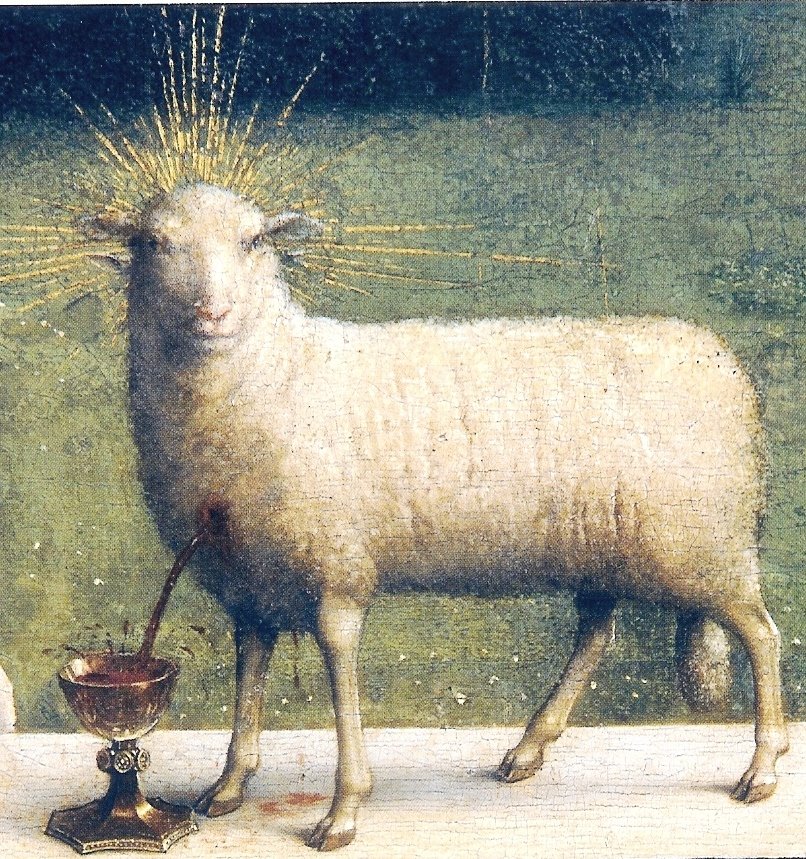
So, returning to John’s vision in the Book of Revelation, the heavenly liturgy (worship) and delight of love in heaven by the blessed community of heaven centers upon Christ, the Lamb that was slain yet is risen and lives. John sees God sitting on a throne in heaven and with him the Lamb of God, who is Christ. In our earthly liturgy we say a number of times "Lamb of God you take away the sins of the world, have mercy on us." The lamb imagery refers to the Jewish Temple sacrifices. Christ’s being slain, that is, dying on the Cross is the prefect sacrifice of love offered for us and our salvation. Without his sacrifice and his love we would be damned, for it is love that saves us. So this what John means when he sees this Lamb who was slain.
 
Detail Lamb of God by van Eyck
 
 
And we hear this Sunday in the Second Reading from the Book of Revelation one of the many references to the thanksgiving, love and worship given to Christ in heaven. But I shall share more about this next week.
 
Listen to Handel’s "Worthy is the Lamb" from The Messiah HERE
 

Thursday, April 4, 2013

Wounds of the Risen Christ

This Sunday, continuing the celebration of the Easter Season, is Divine Mercy Sunday. This Sunday we hear the Gospel account of how the Risen Jesus appeared to his Apostles, and also to Thomas, and showed them his wounds from the Cross. Thomas had insisted that he would only believe that Jesus was risen from the dead if he could actually touch Jesus’ wounds and hence earned the name "Doubting Thomas."


Certainly we can say that the Divine Mercy of Jesus is focused in his wounds which open to his Sacred Heart. In my spiritual journey these wounds of Jesus attract me very much with the sacrificial love they represent. These wounds, especially his Five Wounds (in his hands, feet and side), are marks of the Passion and Cross which he still carries in his glorified, risen body after his Resurrection.
 
The Resurrection means a new and glorified body, called a new creation, not a resuscitated mortal body brought back to mortal existence which can die again. In such a glorified body we would not expect to find wounds; we would expect to find perfection, which presumably excludes any defect which we associate with wounds, scars or other physical disfigurements.


Yet it is in that glorified, risen body that Jesus keeps showing his disciples his wounds taken from the Cross. One preacher said that the reasons for this are first that the wounds show the disciples that the one appearing to them as one who could pass through locked doors (they thought he was a ghost at first! See Luke 24:36-40), is the same Jesus who they knew had been crucified. Second, they are the proofs of his love for us which he demonstrated in his Sacrifice on the Cross. And, third, they tell us that we too will have wounds if we love as Christ loves, but also share his new life as a result. (C. H. Spurgeon Sermons Vol.5:254)
 
I think how some societies celebrated the scars of warriors as marks of valor and battle. Christ’s wounds are signs of his suffering for us and this out of love. The Catechism teaches: "By embracing in his human heart the Father's love for men [all], Jesus ‘loved them to the end’, for ‘greater love has no man than this, that a man lay down his life for his friends.’(John 13:1; 15:13.) In suffering and death his humanity became the free and perfect instrument of his divine love which desires the salvation of men." (#609)

The Jerusalem Cross
depicts the Five Wounds of Christ

 
The Cross and the Wounds Christ received on the Cross are connected, then, with the love of God for us. They tell us that this love is sacrificial (giving) and also that this love is compassionate. Compassion literally means "to suffer with" another, to share another’s suffering, at least in heart and moral support, if not physically also.
 
I think about the wounds in my own life when I have suffered. I have come to know that whatever suffering I may have suffered in my life has helped make me a more compassionate priest, though I have a lot of room to grow in this compassion. For example, I went through a terrible time of depression and panic attacks during one period of my life, even as a priest. Before this, I remember when I was in the Seminary that one of my former College roommates who was in Medical School at the time told me that he had to take off a semester because he was experiencing panic attacks. I didn’t know what he was talking about and I couldn’t appreciate then what serious suffering he was going through. After I had my own experience of this suffering, I can sympathize with others who suffer this kind of affliction and be of help, especially to reassure that this affliction can be cured since I experienced healing of this woundedness.
 
Thank God we don’t have to experience every suffering imaginable to be compassionate! However, Christ Jesus did suffer every wound there is except sin, and I cannot imagine the enormity of such suffering. The result, however, is described by the author of the Letter to the Hebrews 4:14-16:
 
"Therefore, since we have a great high priest who has passed through the heavens, Jesus the Son of God, let us hold fast our confession. For we do not have a high priest who cannot sympathize with our weaknesses, but One who has been tested in all things as we are, yet without sin. Therefore let us draw near with confidence to the throne of grace, so that we may receive mercy and find grace to help in time of need."
 
And St. Bernard of Clairvaux says:
 
"He was thinking thoughts of peace, and I did not know it, for who knows the mind of the Lord, or who has been his counselor? But the piercing nail has become a key to unlock the door, that I may see the good will of the Lord. And what can I see as I look through the hole? Both the nail and the wound cry out that God was in Christ reconciling the world to himself. The lance pierced His soul and came close to His heart, so that he might be able to feel compassion for me in my weaknesses.
 
"Through these sacred wounds we can see the secret of His heart, the great mystery of love, the sincerity of His mercy with which he visited us from on high. Where have Your love, Your mercy, Your compassion shone out more luminously than in Your wounds, sweet, gentle Lord of mercy? More mercy than this no one has than that he lay down his life for those who are doomed to death." (Homily on the Song of Songs)
 
 
The Wounds of Christ also remind us of the essential union of Christ’s Cross and Resurrection. There is not one without the other, so as I often say: "There is no Cross without the Resurrection but also there is no Resurrection without the Cross." This is the Paschal Mystery of Christ: his Dying and Rising, and it is the pattern of our lives.
 
I see in the wounds of Christ, as others have, the reminder also that the path of Christ’s love will inevitably involve a certain amount of wounding, of suffering for others. A story is told about people who didn’t get involved in helping others in life: "We will go before God to be judged, and God will ask us: 'Where are your wounds?' and we will say, 'We have no wounds.' And God will ask, 'Was nothing worth fighting for?'" It might also be asked: "Was there nothing worth suffering for, giving and loving enough to be vulnerable and wounded?"
 
Here is a favorite prayer which mentions the wounds of Christ:
 
Anima Christi (Soul of Christ)
 
Soul of Christ, sanctify me;
Body of Christ, save me;
Blood of Christ, inebriate me;
Water from the side of Christ, wash me;
Passion of Christ, strengthen me;
 
O good Jesus, hear me;
within Your wounds, hide me;
let me never be separated from You;
 
from the evil one, protect me;
at the hour of my death, call me;
and bid me come to You;
that with Your saints,
I may praise You forever and ever.